four-stroke-cycle engine

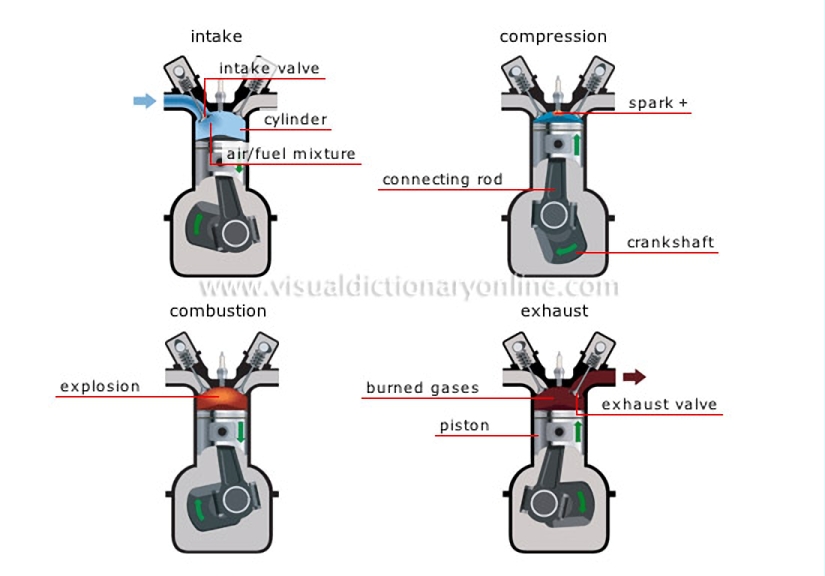
Combustion engine whose cycle (intake, compression, combustion, exhaust) requires two up-and-down movements of the piston.
four-stroke-cycle engine 						Phase during which the exhaust valve opens and the piston moves back up to expel the burned gases.				  							Mixture of gases (carbon monoxide, nitrogen oxide and unburned hydrocarbons) filling the combustion chamber after the explosion.				  							Part that opens to allow the burned gases to escape.				  							Metal moving part in the cylinder and attached to the connecting rod; it compresses the air/fuel mixture, then receives the thrust from the burned gases.				  							Phase during which the expansion of the combustion gases pushes the piston downward, driving the rotation of the crankshaft.				  							Ignition of the air/fuel mixture produces a major energy release that pushes the piston downward.				  							Phase during which the exhaust valve opens and the piston comes down and draws the air/fuel mixture into the combustion chamber.				  							Chamber closed by two valves; in it, the piston moves and the air/fuel mixture is burned.				  							Mixture prepared in the carburetor, containing an amount of fuel proportional to the amount of air entering.				  							Part that opens to let the air/fuel mixture into the cylinder.				  							Phase during which the piston goes up to compress the air/fuel mixture. At the height of the compression, the spark plug produces a spark.				  							Spark produced when an electric current arcs between the two electrodes of a spark plug and ignites the air/fuel mixture.												Shaft consisting of a series of cranks, which convert the alternate rectilinear motion of the piston/connecting rod assembly into a continuous circular motion.				  							Articulated shank powered by the gas explosion; it transmits the thrust from the piston to the crankshaft.
See Also


spark plug

gasoline engine?[1]

exhaust

Phase during which the exhaust valve opens and the piston moves back up to expel the burned gases.

burned gases

Mixture of gases (carbon monoxide, nitrogen oxide and unburned hydrocarbons) filling the combustion chamber after the explosion.

exhaust valve

Part that opens to allow the burned gases to escape.

piston

Metal moving part in the cylinder and attached to the connecting rod; it compresses the air/fuel mixture, then receives the thrust from the burned gases.

combustion

Phase during which the expansion of the combustion gases pushes the piston downward, driving the rotation of the crankshaft.

explosion

Ignition of the air/fuel mixture produces a major energy release that pushes the piston downward.

intake

Phase during which the exhaust valve opens and the piston comes down and draws the air/fuel mixture into the combustion chamber.

cylinder

Chamber closed by two valves; in it, the piston moves and the air/fuel mixture is burned.

air/fuel mixture

Mixture prepared in the carburetor, containing an amount of fuel proportional to the amount of air entering.

intake valve

Part that opens to let the air/fuel mixture into the cylinder.

compression

Phase during which the piston goes up to compress the air/fuel mixture. At the height of the compression, the spark plug produces a spark.

spark

Spark produced when an electric current arcs between the two electrodes of a spark plug and ignites the air/fuel mixture.
spark plug
spark plug

crankshaft

Shaft consisting of a series of cranks, which convert the alternate rectilinear motion of the piston/connecting rod assembly into a continuous circular motion.

connecting rod

Articulated shank powered by the gas explosion; it transmits the thrust from the piston to the crankshaft.