track

During a ski jumping event, each competitor executes two jumps and points are awarded for style and distance.
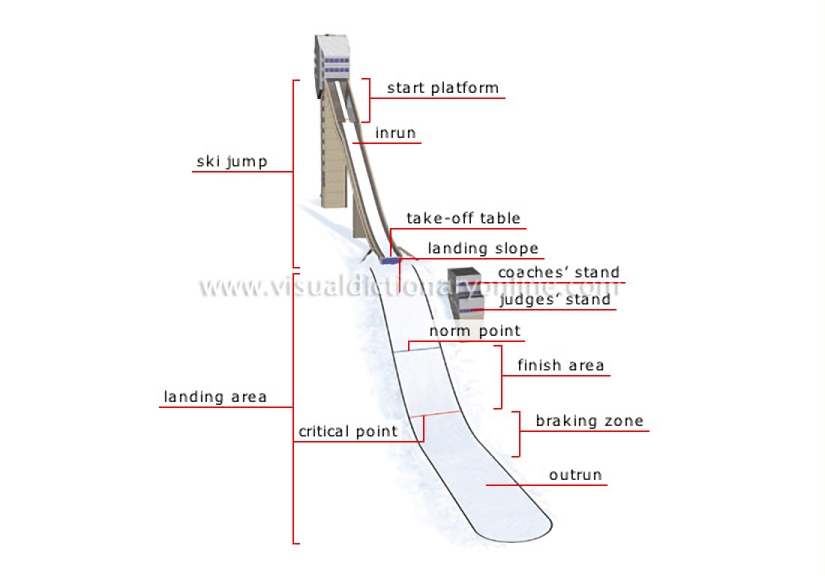
track 						Transition zone between the finish area and the outrun; the braking zone is the area where the ski jumper regains balance and decelerates.				  							Wide, relatively flat area where the skier can stop safely.				  							Point that marks the length of an ideal jump; points are deducted when the landing is short of or added when the ski jumper lands beyond the critical point.				  							Part of the landing area where ski jumpers land; distance markers allow officials to determine the length of each jump.				  							Point marking the start of the finish area.				  							Steep slope in the middle of which the ski jumpers land; it is divided into several sections.				  							Stand reserved for judges; five style judges specifically evaluate take-off precision and control, flight position and landing quality.				  							Stand from which coaches observe the jumps executed by the athletes.				  							Upper part of the landing area; the ski jumper should fly over it during a jump but it does provide a safe landing area in the event of a short jump.				  							Flat surface at the bottom of the ski jump that slopes at an angle of about 10°; the skier takes off from it.				  							Part of the ski jump that allows the jumper to generate the speed required for takeoff; its average incline is 35° to 40°.				  							Top of the inrun where ski jumpers make their starts; the starting point is established by officials before each event.				  							Extremely steep artificial track that is covered with snow; Olympic events are held on a large ski jump (120 m) and on a normal ski jump (90 m).
See Also


jumping technique

ski jumper

braking zone

Transition zone between the finish area and the outrun; the braking zone is the area where the ski jumper regains balance and decelerates.

outrun

Wide, relatively flat area where the skier can stop safely.

critical point

Point that marks the length of an ideal jump; points are deducted when the landing is short of or added when the ski jumper lands beyond the critical point.

finish area

Part of the landing area where ski jumpers land; distance markers allow officials to determine the length of each jump.

norm point

Point marking the start of the finish area.

landing area

Steep slope in the middle of which the ski jumpers land; it is divided into several sections.

judges’ stand

Stand reserved for judges; five style judges specifically evaluate take-off precision and control, flight position and landing quality.

coaches’ stand

Stand from which coaches observe the jumps executed by the athletes.

landing slope

Upper part of the landing area; the ski jumper should fly over it during a jump but it does provide a safe landing area in the event of a short jump.

take-off table

Flat surface at the bottom of the ski jump that slopes at an angle of about 10°; the skier takes off from it.

inrun

Part of the ski jump that allows the jumper to generate the speed required for takeoff; its average incline is 35° to 40°.

start platform

Top of the inrun where ski jumpers make their starts; the starting point is established by officials before each event.

ski jump

Extremely steep artificial track that is covered with snow; Olympic events are held on a large ski jump (120 m) and on a normal ski jump (90 m).