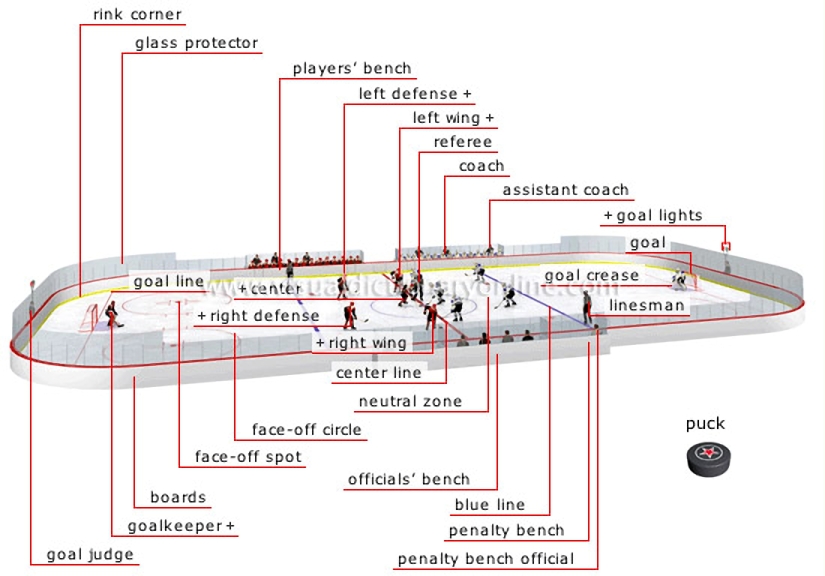
rink

Ice surface on which a hockey game is played; a game consists of three 20-minute periods with two 15-minute intermissions.
rink 						Reinforced glass panel that is mounted on top of the boards to protect spectators from high shots and players’ sticks.				  							Player whose role is to prevent the puck from entering the goal; the goalkeeper usually plays the entire game.												Red line that the puck must cross for a goal to be scored; the red line also marks the icing line.				  							Each of the spots where a referee or linesman drops the puck to put it in play.				  							Circle around each of the five face-off spots; two players line up on each side of this spot for a face-off while the other players remain outside the circle.				  							Position to the left of the center and behind the wing; this player tries to prevent the opponent from approaching the goal.												Wooden or fiberglass boards that surround the rink and delimit the playing area.				  							Bench used by the coaches and by inactive players; each team has about 20 players but only six are on the ice at the same time.				  							Position to the right of the center and behind the wing; this player tries to prevent the opponent from approaching the goal.												The four rounded corners of the rink where body checks are often thrown.				  							Off-ice official who is positioned at the end of the rink behind the goal; the goal judge turns on a red light when the puck crosses the goal line.				  							Person who assists the coach; there are usually two assistant coaches behind the bench, one in charge of the offense and the other in charge of the defense.				  							The team’s leader; the coach plots strategy and decides who plays in different situations.				  							The red light signals a goal while the green light, which is connected to the official time clock, signals a stoppage in play or the end of a period.				  							Official who is responsible for maintaining order on the penalty bench.				  							Area between the two blue lines where player changes are made and where various offensive and defensive strategies are initiated.				  							Offensive position to the left of the center; this player’s role is to score goals and to check the opposing left wing.												Bench reserved for penalized players; penalties vary between two and 10 minutes, depending on the seriousness of the infraction.				  							Bench reserved for some of the off-ice officials (timekeeper and penalty keeper, scorer, announcer).				  							Player who usually takes the face-offs; a key player on a team, the center plays an offensive and a defensive role.												Cage formed of netting mounted on a metal frame; a team scores a goal each time it lodges the puck inside the opposing goal.				  							Semicircle reserved for the goalkeeper; the referee disallows a goal if a player interferes with the goalkeeper inside the goal crease.				  							Two lines that divide the rink into three equal parts; an offside is called when a player crosses the opposing blue line before the puck.				  							Official who is responsible for applying the rules; the referee, who wears a red armband, officiates and drops the puck for face-offs at the start of a period.				  							Line that divides the rink into two zones, one for each team; teams change zones after each period.				  							Offensive position to the right of the center; this player’s role is to score goals and to check the opposing right wing.												One of two officials who signal offsides and icings; they do most of the face-offs and also signal infractions to the referee.				  							Black disk that is made of hard rubber; the puck is refrigerated before a game to improve its sliding action and reduce bouncing.
See Also


goalkeeper?[1]

ice hockey player?[1]

glass protector

Reinforced glass panel that is mounted on top of the boards to protect spectators from high shots and players’ sticks.

goalkeeper

Player whose role is to prevent the puck from entering the goal; the goalkeeper usually plays the entire game.
goalkeeper [1]
goalkeeper [1]

goal line

Red line that the puck must cross for a goal to be scored; the red line also marks the icing line.

face-off spot

Each of the spots where a referee or linesman drops the puck to put it in play.

face-off circle

Circle around each of the five face-off spots; two players line up on each side of this spot for a face-off while the other players remain outside the circle.

left defense

Position to the left of the center and behind the wing; this player tries to prevent the opponent from approaching the goal.
ice hockey player [1]

boards

Wooden or fiberglass boards that surround the rink and delimit the playing area.

players’ bench

Bench used by the coaches and by inactive players; each team has about 20 players but only six are on the ice at the same time.

right defense

Position to the right of the center and behind the wing; this player tries to prevent the opponent from approaching the goal.
ice hockey player [1]

rink corner

The four rounded corners of the rink where body checks are often thrown.

goal judge

Off-ice official who is positioned at the end of the rink behind the goal; the goal judge turns on a red light when the puck crosses the goal line.

assistant coach

Person who assists the coach; there are usually two assistant coaches behind the bench, one in charge of the offense and the other in charge of the defense.

coach

The team’s leader; the coach plots strategy and decides who plays in different situations.

goal lights

The red light signals a goal while the green light, which is connected to the official time clock, signals a stoppage in play or the end of a period.

penalty bench official

Official who is responsible for maintaining order on the penalty bench.

neutral zone

Area between the two blue lines where player changes are made and where various offensive and defensive strategies are initiated.

left wing

Offensive position to the left of the center; this player’s role is to score goals and to check the opposing left wing.
ice hockey player [1]

penalty bench

Bench reserved for penalized players; penalties vary between two and 10 minutes, depending on the seriousness of the infraction.

officials’ bench

Bench reserved for some of the off-ice officials (timekeeper and penalty keeper, scorer, announcer).

center

Player who usually takes the face-offs; a key player on a team, the center plays an offensive and a defensive role.
ice hockey player [1]

goal

Cage formed of netting mounted on a metal frame; a team scores a goal each time it lodges the puck inside the opposing goal.

goal crease

Semicircle reserved for the goalkeeper; the referee disallows a goal if a player interferes with the goalkeeper inside the goal crease.

blue line

Two lines that divide the rink into three equal parts; an offside is called when a player crosses the opposing blue line before the puck.

referee

Official who is responsible for applying the rules; the referee, who wears a red armband, officiates and drops the puck for face-offs at the start of a period.

center line

Line that divides the rink into two zones, one for each team; teams change zones after each period.

right wing

Offensive position to the right of the center; this player’s role is to score goals and to check the opposing right wing.
ice hockey player [1]

linesman

One of two officials who signal offsides and icings; they do most of the face-offs and also signal infractions to the referee.

puck

Black disk that is made of hard rubber; the puck is refrigerated before a game to improve its sliding action and reduce bouncing.