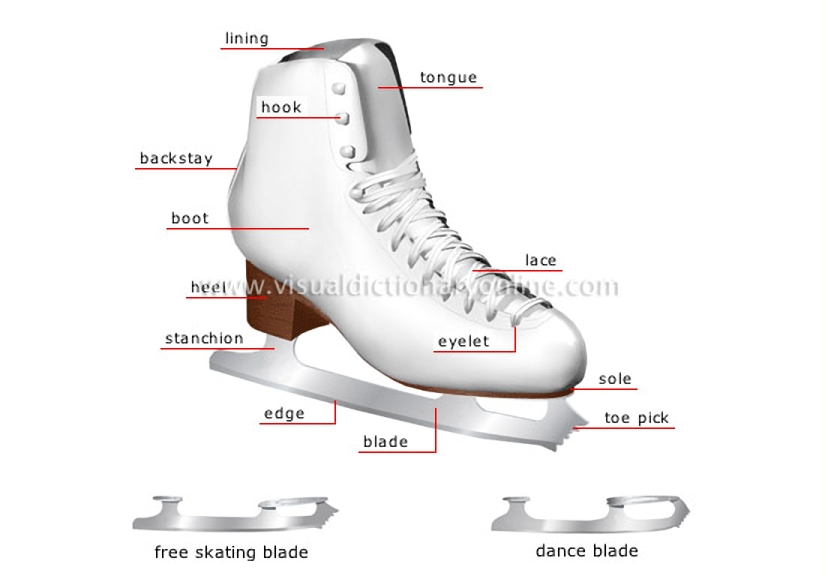
figure skate

Reinforced boot with a blade that makes it possible to glide over the ice; figure skating is hard on the ankles so the skate provides maximum ankle support.
figure skate 						Small teeth at the front end of the blade; they serve as the pivot point during spins and also make it possible to take off and land during jumps.				  							Sturdy plastic or wooden sole that forms the bottom of the boot; the blade screws into the sole.				  							Small metal-rimmed hole through which the lace passes.				  							Narrow cord of fabric or leather, flat or round, that is threaded through eyelets or hooks to tighten the boot.				  							Small piece of curved metal used to attach the lace.				  							Narrow tapering strip of metal that is attached to the sole; the lower part is made of hardened steel to keep the edges sharp.				  							Part of the blade that bites into the ice; the blade has two edges (inside and outside), which are separated by a groove.				  							Vertical part that extends up from the blade to secure it to the sole.				  							Stiff part underneath the boot that supports the back of the foot.				  							Sturdy flexible boot with a lace; it protects and supports the foot and ankle and is made of leather or synthetic materials.				  							Reinforcement at the back of the boot.				  							Padded layer of fabric or leather that covers and protects the inside of the boot.				  							Piece that extends from the boot and prevents the foot from rubbing against the lace; it is lifted to slip the foot into the boot.				  							Blade whose heel is shorter and whose toe picks are less pronounced to facilitate the execution of complex movements and to prevent the toe picks from catching.				  							Blade with toe picks that facilitate the execution of jumps and spins; its curvature is more pronounced than that of the dance blade.
See Also


players skate

in-line skate?[1]

speed skates

goalkeepers skate

toe pick

Small teeth at the front end of the blade; they serve as the pivot point during spins and also make it possible to take off and land during jumps.

sole

Sturdy plastic or wooden sole that forms the bottom of the boot; the blade screws into the sole.

eyelet

Small metal-rimmed hole through which the lace passes.

lace

Narrow cord of fabric or leather, flat or round, that is threaded through eyelets or hooks to tighten the boot.

hook

Small piece of curved metal used to attach the lace.

blade

Narrow tapering strip of metal that is attached to the sole; the lower part is made of hardened steel to keep the edges sharp.

edge

Part of the blade that bites into the ice; the blade has two edges (inside and outside), which are separated by a groove.

stanchion

Vertical part that extends up from the blade to secure it to the sole.

heel

Stiff part underneath the boot that supports the back of the foot.

boot

Sturdy flexible boot with a lace; it protects and supports the foot and ankle and is made of leather or synthetic materials.

backstay

Reinforcement at the back of the boot.

lining

Padded layer of fabric or leather that covers and protects the inside of the boot.

tongue

Piece that extends from the boot and prevents the foot from rubbing against the lace; it is lifted to slip the foot into the boot.

dance blade

Blade whose heel is shorter and whose toe picks are less pronounced to facilitate the execution of complex movements and to prevent the toe picks from catching.

free skating blade

Blade with toe picks that facilitate the execution of jumps and spins; its curvature is more pronounced than that of the dance blade.