cross-country skier

Athlete who practices cross-country skiing; this athlete takes part in various individual (classic, freestyle, pursuit, sprint) and team (relay) events.
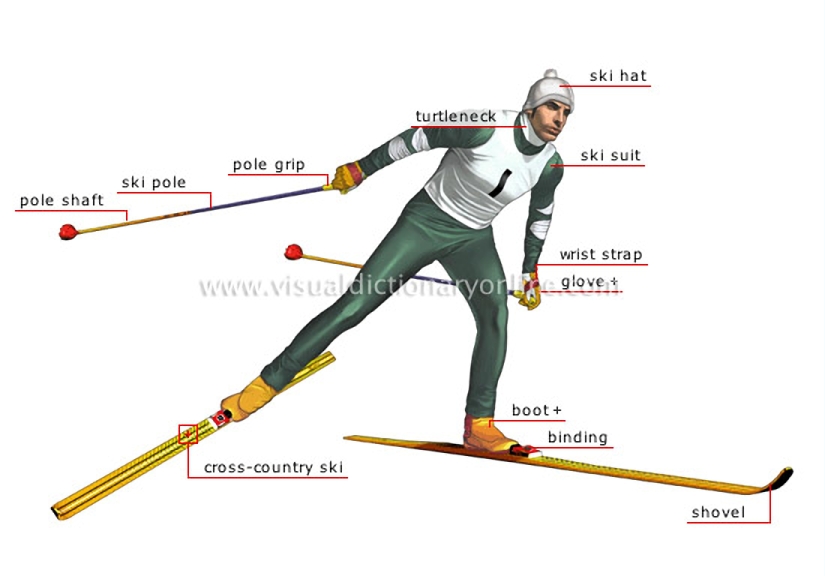
cross-country skier 						Lightweight flexible boot that provides good ankle mobility; the skating step requires a more rigid boot than the traditional boot.												Device of variable form in which the skier places the toe of the boot; it allows the ski to move as one with the skier.				  							Front end of the ski; its upward curve cuts through snow and helps to avoid catching an edge.				  							Long board designed to glide over a snow-covered surface; light and narrow, it has a relatively pronounced camber between the shovel and the tail.										  							Metal or composite fiber rod with a handle and a basket; the ski pole is used for maintaining balance and thrusting.				  							Skintight one-piece garment that reduces air resistance; it is lightweight and allows heat generated by the skier to be released.				  							Knit fabric top with a high collar formed of ribbing that folds over around the neck; it has no closing mechanism.				  					  							Covering for the hand and wrist that protects them against cold and against chafing by the pole handle; it is thinner than an alpine ski glove.												Strap that is attached to the pole grip and worn around the wrist to prevent the skier from losing a pole when sticking it into the ground.				  							Headgear made of a tubular piece of fabric folded back to form a double layer; its top is sewn and sometimes features a pom-pom.
See Also


running shoe

hand

diagonal step

skating step

ski resort?[1]

cross-country ski

boot

Lightweight flexible boot that provides good ankle mobility; the skating step requires a more rigid boot than the traditional boot.
running shoe
running shoe

binding

Device of variable form in which the skier places the toe of the boot; it allows the ski to move as one with the skier.

shovel

Front end of the ski; its upward curve cuts through snow and helps to avoid catching an edge.

cross-country ski

Long board designed to glide over a snow-covered surface; light and narrow, it has a relatively pronounced camber between the shovel and the tail.
cross-country ski
cross-country ski

pole shaft

ski pole

Metal or composite fiber rod with a handle and a basket; the ski pole is used for maintaining balance and thrusting.

ski suit

Skintight one-piece garment that reduces air resistance; it is lightweight and allows heat generated by the skier to be released.

turtleneck

Knit fabric top with a high collar formed of ribbing that folds over around the neck; it has no closing mechanism.

pole grip

glove

Covering for the hand and wrist that protects them against cold and against chafing by the pole handle; it is thinner than an alpine ski glove.
hand
hand

wrist strap

Strap that is attached to the pole grip and worn around the wrist to prevent the skier from losing a pole when sticking it into the ground.

ski hat

Headgear made of a tubular piece of fabric folded back to form a double layer; its top is sewn and sometimes features a pom-pom.