court

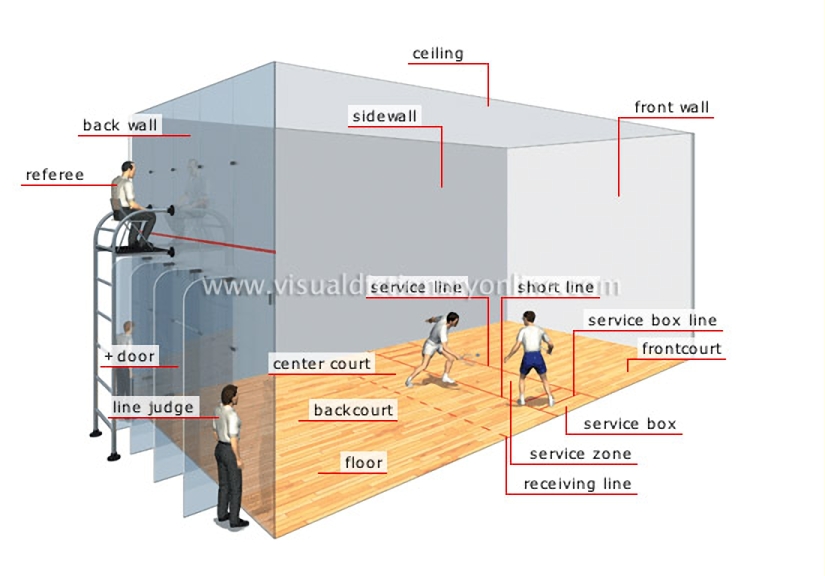
Enclosed space whose surfaces make up the playing area; it is 40 ft long, 20 ft wide and 20 ft high.
court 						Official responsible for applying the rules; the referee ensures that the match runs smoothly and rules on contentious points.				  							The two officials who, at the request of the referee or a player, confirm or reverse the referee’s decision.				  							Glass-covered opening used to access the racquetball court.												Zone between the short line and the back wall.				  							Horizontal surface that is usually made of wooden slats; the ball may only bounce once on it.				  							Line that the receiver stands behind; the receiver may not step over the receiving line until the serve crosses it.				  							Part of the court behind the short line and between the sidewalls; it is a strategic zone that players attempt to control.				  							Line marking the front of the service zone.				  							Zone where a player stands to serve; the ball must bounce once in this zone before it is served.				  							In doubles play, the server’s partner must stay inside this area until the ball crosses the short line.				  							Line drawn 18 in from the sidewall that marks the service box at both ends of the service zone.				  							Line dividing the court in half; the serve must cross the short line after bouncing off the front wall.				  							Area between the front wall and the short line.				  							Wall marking the back of the court behind the players.				  							Wall marking the sides of the court.				  							Wall facing the players; the service is made onto it.				  							Horizontal surface making up the upper part of the court; the ceiling is part of the playing area.
See Also


examples of doors?[1]

referee

Official responsible for applying the rules; the referee ensures that the match runs smoothly and rules on contentious points.

line judge

The two officials who, at the request of the referee or a player, confirm or reverse the referee’s decision.

door

Glass-covered opening used to access the racquetball court.
examples of doors [1]

backcourt

Zone between the short line and the back wall.

floor

Horizontal surface that is usually made of wooden slats; the ball may only bounce once on it.

receiving line

Line that the receiver stands behind; the receiver may not step over the receiving line until the serve crosses it.

center court

Part of the court behind the short line and between the sidewalls; it is a strategic zone that players attempt to control.

service line

Line marking the front of the service zone.

service zone

Zone where a player stands to serve; the ball must bounce once in this zone before it is served.

service box

In doubles play, the server’s partner must stay inside this area until the ball crosses the short line.

service box line

Line drawn 18 in from the sidewall that marks the service box at both ends of the service zone.

short line

Line dividing the court in half; the serve must cross the short line after bouncing off the front wall.

frontcourt

Area between the front wall and the short line.

back wall

Wall marking the back of the court behind the players.

sidewall

Wall marking the sides of the court.

front wall

Wall facing the players; the service is made onto it.

ceiling

Horizontal surface making up the upper part of the court; the ceiling is part of the playing area.