table

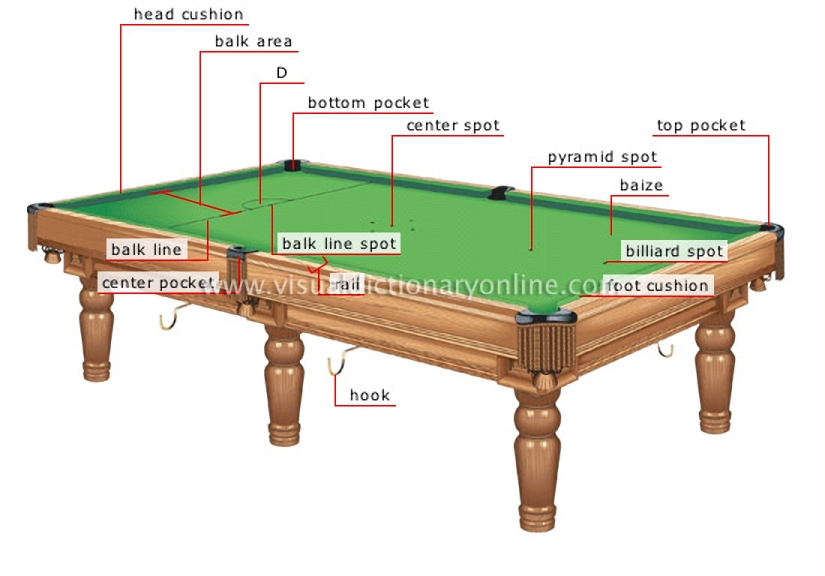
Surface on which the balls roll; it is supported by legs, has a rectangular top and is horizontal and level.
table 						Corner pocket located at the foot cushion and opposite the balk area.				  							Corner pocket located at the head cushion and next to the balk area.				  							Semicircle whose center is on and in the middle of the balk line; the game starts from here.				  							Rubber padding that covers the inner side of the rail next to the balk area; the balls bounce against it.				  							Table frame to which the rubber is attached and covered with felt; it delimits the playing surface.				  							Rubber padding that covers the inner side of the rail opposite the balk area; the balls bounce against it.				  							Spot that marks the position of the black ball in snooker; it is about 13 in from the foot cushion on the table’s longitudinal center line.				  							Spot that marks the position of the pink ball in snooker; it is halfway between the center spot and the foot cushion on the table’s longitudinal center line.				  							Felt fabric that covers the playing surface and the inner side of the rails.				  							Side pocket in the middle of the table’s side rail.				  							Curved part positioned along the tables that holds the cues and the rack.				  							Zone bordered by the balk line and the head cushion, including the 						Line marked across the width of the table 29 in from the head cushion; it serves as a benchmark for snooker at the start of the game.				  							Spot that marks the position of the blue ball in snooker; it is located halfway between the center pockets and the head and foot cushions.				  							Spot in the middle of the balk line that marks the position of the brown ball in snooker (there are two other spots at the intersections of the balk line and the

See Also


English billiards

snooker

top pocket

Corner pocket located at the foot cushion and opposite the balk area.

bottom pocket

Corner pocket located at the head cushion and next to the balk area.

D

Semicircle whose center is on and in the middle of the balk line; the game starts from here.

head cushion

Rubber padding that covers the inner side of the rail next to the balk area; the balls bounce against it.

rail

Table frame to which the rubber is attached and covered with felt; it delimits the playing surface.

foot cushion

Rubber padding that covers the inner side of the rail opposite the balk area; the balls bounce against it.

billiard spot

Spot that marks the position of the black ball in snooker; it is about 13 in from the foot cushion on the table’s longitudinal center line.

pyramid spot

Spot that marks the position of the pink ball in snooker; it is halfway between the center spot and the foot cushion on the table’s longitudinal center line.

baize

Felt fabric that covers the playing surface and the inner side of the rails.

center pocket

Side pocket in the middle of the table’s side rail.

hook

Curved part positioned along the tables that holds the cues and the rack.

balk area

Zone bordered by the balk line and the head cushion, including the "D"; this zone is used only in English billiards.

balk line

Line marked across the width of the table 29 in from the head cushion; it serves as a benchmark for snooker at the start of the game.

center spot

Spot that marks the position of the blue ball in snooker; it is located halfway between the center pockets and the head and foot cushions.

balk line spot

Spot in the middle of the balk line that marks the position of the brown ball in snooker (there are two other spots at the intersections of the balk line and the "D").