mountaineer

Person who climbs mountains.
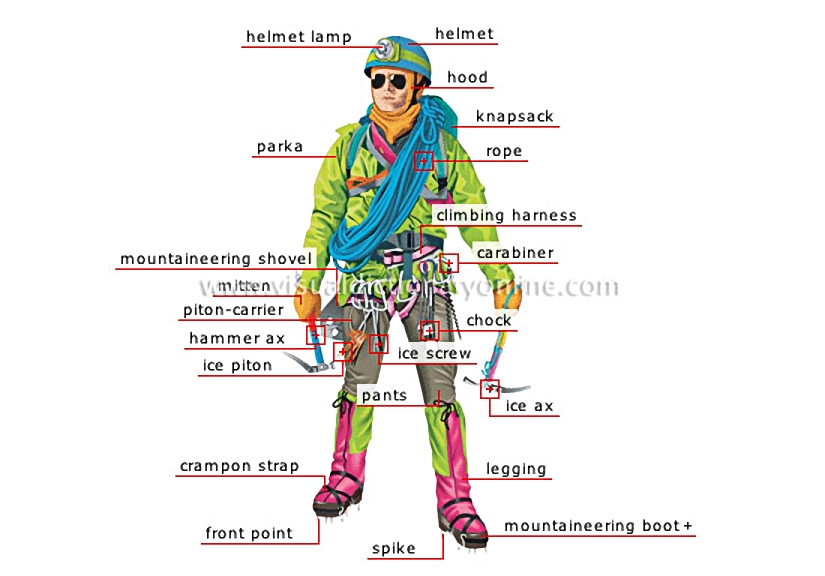
mountaineer 						Small ax used by the mountaineer for cutting footholds, judging snow depth, gaining a firm grip in ice or hard-packed snow, etc.												Waterproof pants that usually extend below the knee.				  							Piece of sturdy waterproof fabric that covers the leg.				  							Sturdy shoe with spikes that is used to advance over snow or ice.												Pointed object that provides balance and prevents slipping when the mountaineer is moving over snow or ice.				  							Each of the front spikes; they are tilted at a 45° angle.				  							Strap used to attach spikes to the sole of the shoe.				  							Threaded metal tube that is screwed into ice or hard-packed snow to help with belaying and advancing.												Metal spike with a blade that is driven into ice or hard-packed snow; it ends in an eye to which a belay rope can be attached using a carabiner.												Hammer that doubles as an ice ax; it is used to drive in pitons, cut footholds, break ice on the rock face, etc.												Covering with a separation only for the thumb, providing better protection against the cold while allowing the wearer to grasp objects.				  							Instrument used to dig and remove snow.				  							Metal ring on which pitons are hung.				  							Metal ring that opens and closes with a spring-loaded gate and that might be equipped with a locking device; it is used to attach rope to a piton, a chock, etc.												Thin cable with a braided center core that makes it stretchy and strong and a woven sheath that surrounds and protects the core.												Lamp that is attached to the helmet so that the mountaineer’s hands remain free.				  							Metal device that is inserted into a crack in the rock face and held in place by tension; it is extended by a steel cable to which a carabiner can snap on.												Accessory connected to the belay rope that consists of a number of straps; it supports the mountaineer’s thighs and pelvis, back and sometimes shoulders.				  							Waterproof sports jacket with long sleeves, a drawstring hood and waist and gathered wrists.				  							Travel or hiking bag that is worn on the back and is used to transport clothing, camping equipment, etc.				  							Headgear that covers the head and neck with an opening for the face.				  							Solid piece of equipment to protect the head from falling rocks or impacts with rock or ice.
See Also


running shoe

mountain

glacier

ice ax

tubular ice screw

piton

hammer ax

locking carabiner

rope

chock

ice ax

Small ax used by the mountaineer for cutting footholds, judging snow depth, gaining a firm grip in ice or hard-packed snow, etc.
ice ax
ice ax

pants

Waterproof pants that usually extend below the knee.

legging

Piece of sturdy waterproof fabric that covers the leg.

mountaineering boot

Sturdy shoe with spikes that is used to advance over snow or ice.
running shoe
running shoe

spike

Pointed object that provides balance and prevents slipping when the mountaineer is moving over snow or ice.

front point

Each of the front spikes; they are tilted at a 45° angle.

crampon strap

Strap used to attach spikes to the sole of the shoe.

ice screw

Threaded metal tube that is screwed into ice or hard-packed snow to help with belaying and advancing.
tubular ice screw
tubular ice screw

ice piton

Metal spike with a blade that is driven into ice or hard-packed snow; it ends in an eye to which a belay rope can be attached using a carabiner.
piton
piton

hammer ax

Hammer that doubles as an ice ax; it is used to drive in pitons, cut footholds, break ice on the rock face, etc.
hammer ax
hammer ax

mitten

Covering with a separation only for the thumb, providing better protection against the cold while allowing the wearer to grasp objects.

mountaineering shovel

Instrument used to dig and remove snow.

piton-carrier

Metal ring on which pitons are hung.

carabiner

Metal ring that opens and closes with a spring-loaded gate and that might be equipped with a locking device; it is used to attach rope to a piton, a chock, etc.
locking carabiner
locking carabiner

rope

Thin cable with a braided center core that makes it stretchy and strong and a woven sheath that surrounds and protects the core.
rope
rope

helmet lamp

Lamp that is attached to the helmet so that the mountaineer’s hands remain free.

chock

Metal device that is inserted into a crack in the rock face and held in place by tension; it is extended by a steel cable to which a carabiner can snap on.
chock
chock

climbing harness

Accessory connected to the belay rope that consists of a number of straps; it supports the mountaineer’s thighs and pelvis, back and sometimes shoulders.

parka

Waterproof sports jacket with long sleeves, a drawstring hood and waist and gathered wrists.

knapsack

Travel or hiking bag that is worn on the back and is used to transport clothing, camping equipment, etc.

hood

Headgear that covers the head and neck with an opening for the face.

helmet

Solid piece of equipment to protect the head from falling rocks or impacts with rock or ice.