Monopoly®

Board game where the players buy, sell and rent property in order to get rich; the richest player wins the game.
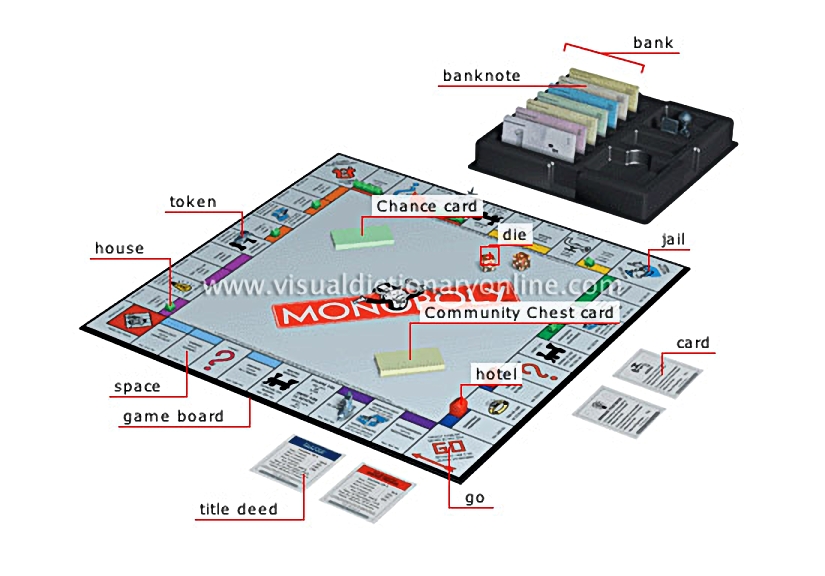
Monopoly® 						Place where the money, title deeds, houses and hotels are stored until a player acquires them.				  							Object that increases a property’s value; to buy a hotel, a player must own four houses on each of the properties in a color group.				  							Object that increases a property’s value; to buy a house, a player must own all the properties in a color group.				  							Space where a player is sent if that person lands on the space marked 						Card the player draws at random after landing on a space specifying the player must do so; these cards give the player instructions (move a token, receive money, etc.).				  							Card the player draws at random after landing on a space specifying the player must do so; these cards give the player instructions (make a payment, go to jail, etc.).				  							Space from which the players start out to begin the game; each time a player passes 						Paper money used as currency to make and receive payments.				  							Proof that a property has been purchased; a player who owns a property can charge the other players rent when they land on that space.				  							Piece of cardboard with information regarding title deed (purchase price, rental cost, house and hotel prices, mortgage value, etc.).				  							Each of the areas into which the game board is divided; they correspond to properties (big city streets), public utilities, railroads, jail, etc.				  							Playing surface that is divided into spaces around which the tokens move; houses, hotels, Chance and Community Chest cards are laid out on it.				  							One of the two small cubes marked on each side with one to six pips.												Small object representing a car, locomotive, hat, etc. that is used by players to move around the board.
See Also


ordinary die

bank

Place where the money, title deeds, houses and hotels are stored until a player acquires them.

hotel

Object that increases a property’s value; to buy a hotel, a player must own four houses on each of the properties in a color group.

house

Object that increases a property’s value; to buy a house, a player must own all the properties in a color group.

jail

Space where a player is sent if that person lands on the space marked "go to jail", draws the card marked "go to jail" or throws doubles three times in succession.

Community Chest card

Card the player draws at random after landing on a space specifying the player must do so; these cards give the player instructions (move a token, receive money, etc.).

Chance card

Card the player draws at random after landing on a space specifying the player must do so; these cards give the player instructions (make a payment, go to jail, etc.).

go

Space from which the players start out to begin the game; each time a player passes "go" or lands on that space, the bank pays the player a salary.

banknote

Paper money used as currency to make and receive payments.

title deed

Proof that a property has been purchased; a player who owns a property can charge the other players rent when they land on that space.

card

Piece of cardboard with information regarding title deed (purchase price, rental cost, house and hotel prices, mortgage value, etc.).

space

Each of the areas into which the game board is divided; they correspond to properties (big city streets), public utilities, railroads, jail, etc.

game board

Playing surface that is divided into spaces around which the tokens move; houses, hotels, Chance and Community Chest cards are laid out on it.

die

One of the two small cubes marked on each side with one to six pips.
ordinary die
ordinary die

token

Small object representing a car, locomotive, hat, etc. that is used by players to move around the board.