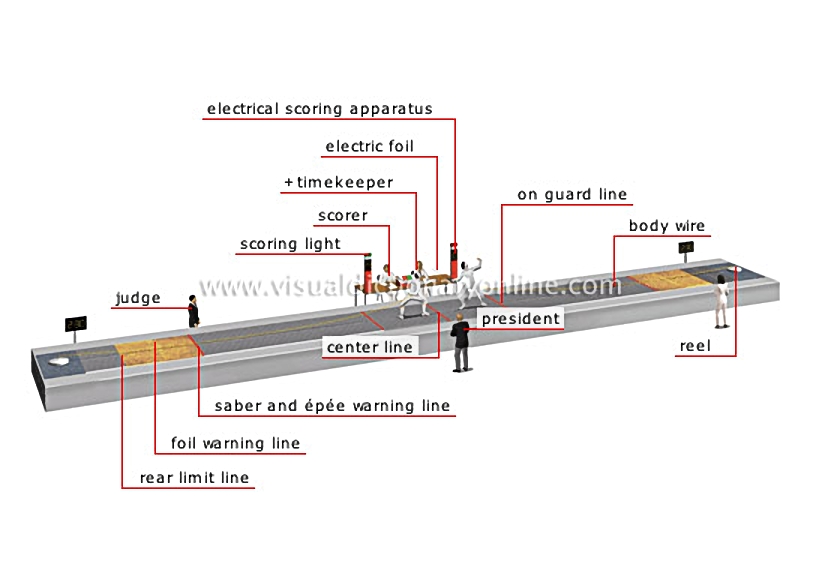
piste

Area on which the match takes place; it is 46 ft long and between 5 and 6.5 ft wide.
piste 						Each of the officials who assist the president; they stand beside the piste and especially check the validity of the hits.				  							Official who registers the fencers’ hits and penalties.				  							Official who enforces the rules and is especially in charge of conducting the match and controlling the scoring apparatus.				  							Device that keeps the body wire under constant tension by following the forward and backward movements of the fencer.				  							Official who monitors the duration of the match; a single match is made up of three manches (sets) of three minutes, with a one-minute break between each manche.				  							Light that switches on to signal valid hits (red and green lights) and nonvalid hits (white lights).				  							Line 3.2 ft from the rear limit line warning the foilist that the end of the piste is near.				  							Line 23 ft from the center line that indicates that the fencer is outside the piste; when a fencer passes this line, a hit is awarded to the opponent.				  							Its end contains an electric button that senses hits; a hit is registered only when the pressure on the tip of the blade is greater than 1.1 lb (maximum weight of the foil).				  							Electrical apparatus for registering the fencers’ hits by means of a body wire.				  							Insulated electric wire that runs through the fencer’s equipment and connects the weapon to the electrical scoring apparatus by means of the reel.				  							Line 6.5 ft from the center line; the fencer must stay behind it to start and when resuming combat after a valid hit.				  							Line that divides the piste into two equal parts, one for each fencer.				  							Line 6.5 ft from the rear limit line to warn the épéeist and the sabreur that they are near the end of the piste.

See Also


fencer

judge

Each of the officials who assist the president; they stand beside the piste and especially check the validity of the hits.

scorer

Official who registers the fencers’ hits and penalties.

president

Official who enforces the rules and is especially in charge of conducting the match and controlling the scoring apparatus.

reel

Device that keeps the body wire under constant tension by following the forward and backward movements of the fencer.

timekeeper

Official who monitors the duration of the match; a single match is made up of three manches (sets) of three minutes, with a one-minute break between each manche.

scoring light

Light that switches on to signal valid hits (red and green lights) and nonvalid hits (white lights).

foil warning line

Line 3.2 ft from the rear limit line warning the foilist that the end of the piste is near.

rear limit line

Line 23 ft from the center line that indicates that the fencer is outside the piste; when a fencer passes this line, a hit is awarded to the opponent.

electric foil

Its end contains an electric button that senses hits; a hit is registered only when the pressure on the tip of the blade is greater than 1.1 lb (maximum weight of the foil).

electrical scoring apparatus

Electrical apparatus for registering the fencers’ hits by means of a body wire.

body wire

Insulated electric wire that runs through the fencer’s equipment and connects the weapon to the electrical scoring apparatus by means of the reel.

on guard line

Line 6.5 ft from the center line; the fencer must stay behind it to start and when resuming combat after a valid hit.

center line

Line that divides the piste into two equal parts, one for each fencer.

saber and épée warning line

Line 6.5 ft from the rear limit line to warn the épéeist and the sabreur that they are near the end of the piste.