court

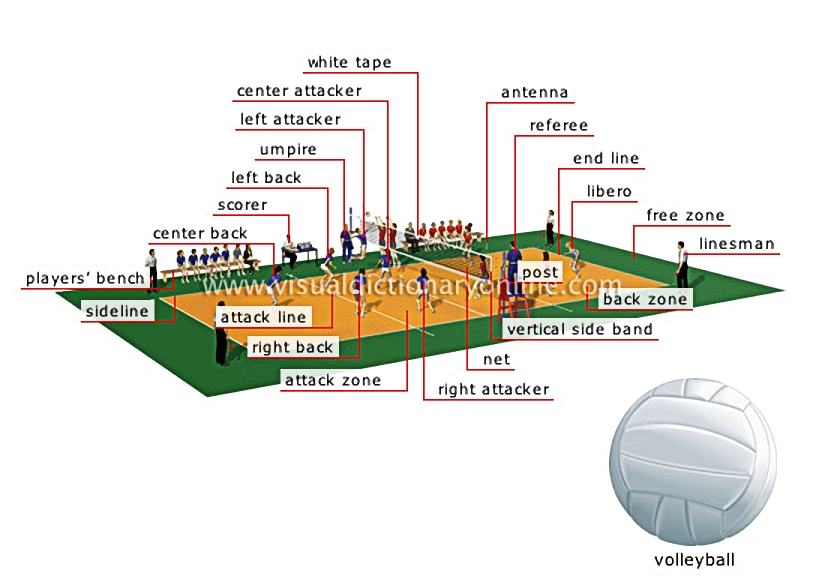
Hard rectangular surface (30 ft x 60 ft) on which a volleyball game is played; the first team to win three sets wins the game.
court 						Line 10 ft from the net; the backs must make attack hits from behind this line.				  							Loosely stitched divider stretched across the middle of the court; players must hit the ball over it.				  							Position in the back zone; this player’s main role is to recover long balls and blocked balls.				  							Position on the right side of the back zone; this player’s main role is making digs on short balls.				  							One of four officials who use a red flag to signal a dead ball, service faults, contact with the antennas, etc.				  							Line that demarcates the sides of the play area; a rally ends when the ball falls outside the sideline.				  							Official responsible for applying the rules; this individual follows the game from a raised platform set up at one end of the net.				  							Position that covers the center of the attack zone; this player’s main role is to counter the opponent’s attacks.				  							Position to the right of the attack zone; this player’s main role is making attack hits to score points.				  							Position specialized in receiving serves; this player only plays back while other teammates change positions during the course of a game.				  							Strip of tape with a cable passing through it; it is attached to posts to suspend the net.				  							Flexible rods at each end of the net; they mark off the net area and the ball must stay inside them to remain in play.				  							Upright used to stretch the net using white tape; the top of the net is just over 2 m above floor level.				  							Vertical strip of white canvas at the ends of the net.				  							Position on the left side of the back zone; this player’s main role is making digs on short balls.				  							Area between the net and the attack line; it is usually occupied by the attackers.				  							Position to the left of the attack zone; this player’s main role is making attack hits to score points.				  							Official who signals net faults or faults committed on the attack line and advises the referee when required.				  							Official who fills in the score sheet, calls stoppages in play and supervises player rotations.				  							Area for substitute players and coaches; a team can have 12 players, six of whom are on the court during play.				  							Area between the attack line and the end line; it is usually occupied by the backs.				  							Area at least 6.5 ft wide surrounding the court.				  							Line demarcating the ends of the court; the right back takes position behind this line to deliver a serve.				  							Inflated ball covered with soft leather and with a circumference of about 26 in; it must always be hit and cannot be held or thrown.
attack line

Line 10 ft from the net; the backs must make attack hits from behind this line.

net

Loosely stitched divider stretched across the middle of the court; players must hit the ball over it.

center back

Position in the back zone; this player’s main role is to recover long balls and blocked balls.

right back

Position on the right side of the back zone; this player’s main role is making digs on short balls.

linesman

One of four officials who use a red flag to signal a dead ball, service faults, contact with the antennas, etc.

sideline

Line that demarcates the sides of the play area; a rally ends when the ball falls outside the sideline.

referee

Official responsible for applying the rules; this individual follows the game from a raised platform set up at one end of the net.

center attacker

Position that covers the center of the attack zone; this player’s main role is to counter the opponent’s attacks.

right attacker

Position to the right of the attack zone; this player’s main role is making attack hits to score points.

libero

Position specialized in receiving serves; this player only plays back while other teammates change positions during the course of a game.

white tape

Strip of tape with a cable passing through it; it is attached to posts to suspend the net.

antenna

Flexible rods at each end of the net; they mark off the net area and the ball must stay inside them to remain in play.

post

Upright used to stretch the net using white tape; the top of the net is just over 2 m above floor level.

vertical side band

Vertical strip of white canvas at the ends of the net.

left back

Position on the left side of the back zone; this player’s main role is making digs on short balls.

attack zone

Area between the net and the attack line; it is usually occupied by the attackers.

left attacker

Position to the left of the attack zone; this player’s main role is making attack hits to score points.

umpire

Official who signals net faults or faults committed on the attack line and advises the referee when required.

scorer

Official who fills in the score sheet, calls stoppages in play and supervises player rotations.

players’ bench

Area for substitute players and coaches; a team can have 12 players, six of whom are on the court during play.

back zone

Area between the attack line and the end line; it is usually occupied by the backs.

free zone

Area at least 6.5 ft wide surrounding the court.

end line

Line demarcating the ends of the court; the right back takes position behind this line to deliver a serve.

volleyball

Inflated ball covered with soft leather and with a circumference of about 26 in; it must always be hit and cannot be held or thrown.