court

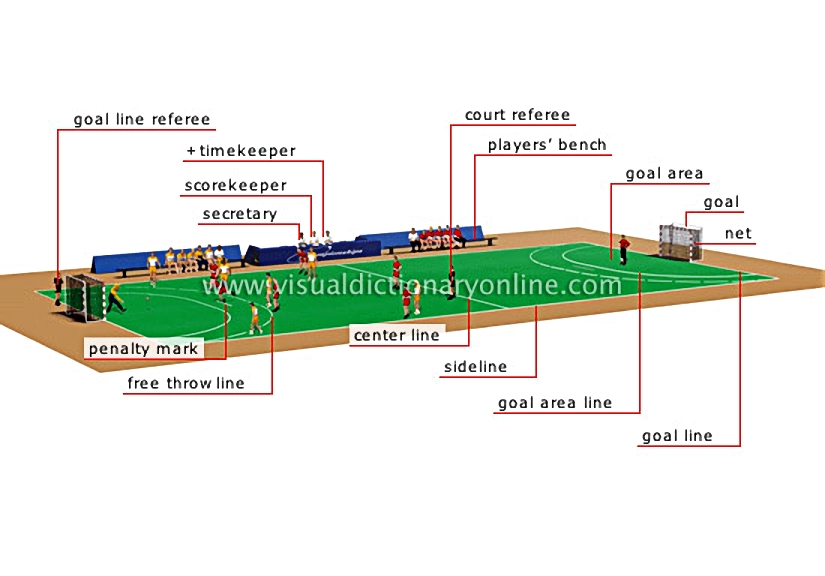
Hard rectangular surface (20 m x 40 m) on which a handball game is played; a game is made up of two 30-minute periods with a 10-minute break between them.
court 						Official in charge of timing the game and suspensions and substitute player changes.				  							Official responsible for applying the rules; positioned in the center of the court, this individual mainly signals player infractions.				  							Line along the sides of the court; when the ball crosses this line, it is put back into play at the same place.				  							Official responsible for applying the rules; positioned near the goal line, this individual signals infractions and decides if a goal counts.				  							Area for substitute players and coaches; a team can have up to 12 players, seven of whom are on the court at one time.				  							Line at the ends of the court that demarcates the play area; a goal is scored when the ball crosses this line.				  							Arc drawn 6 m from the goal; it demarcates the goal area.				  							Arc drawn 9 m from the goal; during a 7 m free throw, all players except the shooter must be outside the zone demarcated by this line.				  							Line parallel to the goal line and 7 m from it; a 7 m free throw (a shot awarded after a penalty) is taken from behind this line.				  							Official who keeps the lineup card and marks the scorecard (goals allowed, expulsions, etc.).				  							Official in charge of timekeeping.				  							Cage made up of a net mounted on a frame; a team scores a point each time it succeeds in placing the ball in the opposing goal.				  							Loosely stitched netting attached to the back of the post; it keeps the ball inside the goal.				  							Semicircular zone reserved for the goalkeeper; a player with ball possession may jump above this area when taking a shot.				  							Line dividing the court into two zones, one for each team; throw-offs are held on this line at the start of a period and after a goal.
scorekeeper

Official in charge of timing the game and suspensions and substitute player changes.

court referee

Official responsible for applying the rules; positioned in the center of the court, this individual mainly signals player infractions.

sideline

Line along the sides of the court; when the ball crosses this line, it is put back into play at the same place.

goal line referee

Official responsible for applying the rules; positioned near the goal line, this individual signals infractions and decides if a goal counts.

players’ bench

Area for substitute players and coaches; a team can have up to 12 players, seven of whom are on the court at one time.

goal line

Line at the ends of the court that demarcates the play area; a goal is scored when the ball crosses this line.

goal area line

Arc drawn 6 m from the goal; it demarcates the goal area.

free throw line

Arc drawn 9 m from the goal; during a 7 m free throw, all players except the shooter must be outside the zone demarcated by this line.

penalty mark

Line parallel to the goal line and 7 m from it; a 7 m free throw (a shot awarded after a penalty) is taken from behind this line.

secretary

Official who keeps the lineup card and marks the scorecard (goals allowed, expulsions, etc.).

timekeeper

Official in charge of timekeeping.

goal

Cage made up of a net mounted on a frame; a team scores a point each time it succeeds in placing the ball in the opposing goal.

net

Loosely stitched netting attached to the back of the post; it keeps the ball inside the goal.

goal area

Semicircular zone reserved for the goalkeeper; a player with ball possession may jump above this area when taking a shot.

center line

Line dividing the court into two zones, one for each team; throw-offs are held on this line at the start of a period and after a goal.