playing field

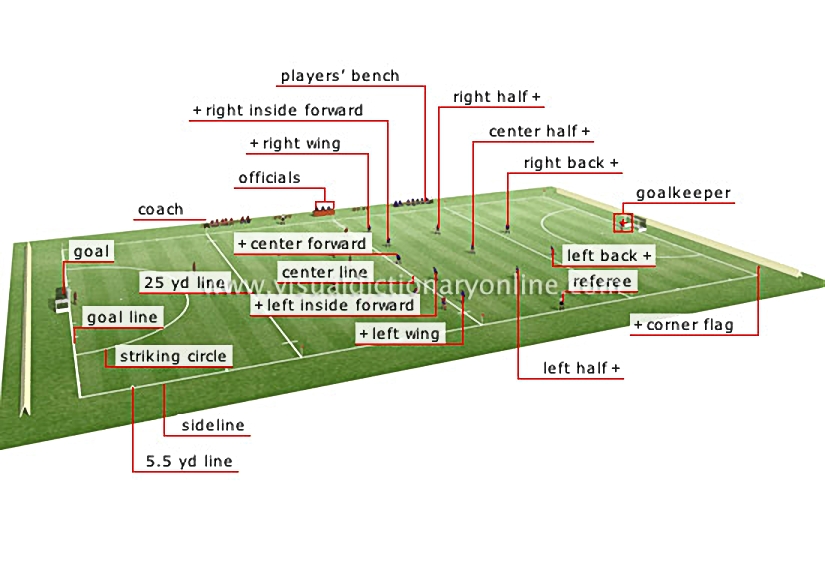
Surface covered with natural or synthetic grass (60 yd x 100 yd) on which a field hockey game is played; a game is made up of two 35-minute periods.
playing field 						Line marking the sides of the playing field; when the ball crosses this line, the opposing team puts it back into play at the same place.				  							Line used to position the players when the ball is put back into play; positioning depends on whether the ball went out of play between the 25 yd lines or between one of them and the goal line.				  							Line marking the ends of the playing field; the ball must cross this line for the goal to count as a point.				  							The team’s leader; the coach plots strategy and decides who plays in different situations.				  							Line where the attacker puts the ball back into play if the defenders push it behind their own goal line.				  							Semicircle located in front of the goal; a goal can only be scored when the attacker hits the ball inside the opponent’s striking circle.				  							Cage made up of a net mounted on a frame; a goal is scored each time a team hits the ball into the opposing goal from inside the striking circle.				  							Area reserved for substitute players and coaches; a team can have up to 16 players but only 11 play at once.				  							One of two officials responsible for applying the rules; this individual penalizes players who commit infractions and awards penalty shots.				  							Individuals in charge of keeping time, recording player substitutions and filling out the score sheet.				  							Offensive position to the right of the center forward and near the sideline; this player’s main role is to thwart opponents and score goals.												Defensive position behind the halfs on the right side of the field; this player attempts to prevent the opponent from creating scoring chances.												Position to the right of the center half; this player tries to take the ball from the opponent and move it up to the wings or forwards.												Offensive position that covers the center of the field; this player tries to score goals by getting within the striking circle.												Position to the right of the center forward; a true playmaker, this player receives passes from the defenders or halfs and creates offensive chances.												Small post with a flag on top; it marks the intersection of the goal line and the sideline.												Defensive position behind the halfs on the left side of the field; this player’s role is to prevent the opponent from obtaining scoring chances.												Key position behind the backs in the center of the field; this player receives the ball and passes it in any direction.												Position to the left of the center half; this player’s main role is to take the ball from the opponent and move it up to the wings or forwards.												Offensive position to the left of the center forward and near the sideline; this player’s main role is to thwart opponents and score goals.												Position to the left of the center forward; a true playmaker, this player receives passes from defenders or halfs and generates offensive chances.												Line dividing the field into two zones, one for each team; face-offs are held on this line at the start of a period and after a goal is scored.				  							Player whose role is to prevent the ball from entering the goal; the goalkeeper may touch the ball with any part of the body but cannot hold it with the hands.
See Also


field player

flag shapes?[1]

goalkeeper

sideline

Line marking the sides of the playing field; when the ball crosses this line, the opposing team puts it back into play at the same place.

25 yd line

Line used to position the players when the ball is put back into play; positioning depends on whether the ball went out of play between the 25 yd lines or between one of them and the goal line.

goal line

Line marking the ends of the playing field; the ball must cross this line for the goal to count as a point.

coach

The team’s leader; the coach plots strategy and decides who plays in different situations.

5.5 yd line

Line where the attacker puts the ball back into play if the defenders push it behind their own goal line.

striking circle

Semicircle located in front of the goal; a goal can only be scored when the attacker hits the ball inside the opponent’s striking circle.

goal

Cage made up of a net mounted on a frame; a goal is scored each time a team hits the ball into the opposing goal from inside the striking circle.

players’ bench

Area reserved for substitute players and coaches; a team can have up to 16 players but only 11 play at once.

referee

One of two officials responsible for applying the rules; this individual penalizes players who commit infractions and awards penalty shots.

officials

Individuals in charge of keeping time, recording player substitutions and filling out the score sheet.

right wing

Offensive position to the right of the center forward and near the sideline; this player’s main role is to thwart opponents and score goals.
field player
field player

right back

Defensive position behind the halfs on the right side of the field; this player attempts to prevent the opponent from creating scoring chances.
field player
field player

right half

Position to the right of the center half; this player tries to take the ball from the opponent and move it up to the wings or forwards.
field player
field player

center forward

Offensive position that covers the center of the field; this player tries to score goals by getting within the striking circle.
field player
field player

right inside forward

Position to the right of the center forward; a true playmaker, this player receives passes from the defenders or halfs and creates offensive chances.
field player
field player

corner flag

Small post with a flag on top; it marks the intersection of the goal line and the sideline.
flag shapes [1]
flag shapes [1]

left back

Defensive position behind the halfs on the left side of the field; this player’s role is to prevent the opponent from obtaining scoring chances.
field player
field player

center half

Key position behind the backs in the center of the field; this player receives the ball and passes it in any direction.
field player
field player

left half

Position to the left of the center half; this player’s main role is to take the ball from the opponent and move it up to the wings or forwards.
field player
field player

left wing

Offensive position to the left of the center forward and near the sideline; this player’s main role is to thwart opponents and score goals.
field player
field player

left inside forward

Position to the left of the center forward; a true playmaker, this player receives passes from defenders or halfs and generates offensive chances.
field player
field player

center line

Line dividing the field into two zones, one for each team; face-offs are held on this line at the start of a period and after a goal is scored.

goalkeeper

Player whose role is to prevent the ball from entering the goal; the goalkeeper may touch the ball with any part of the body but cannot hold it with the hands.
goalkeeper
goalkeeper