court

Hard rectangular surface (50 ft x 94 ft) on which a basketball game is played.
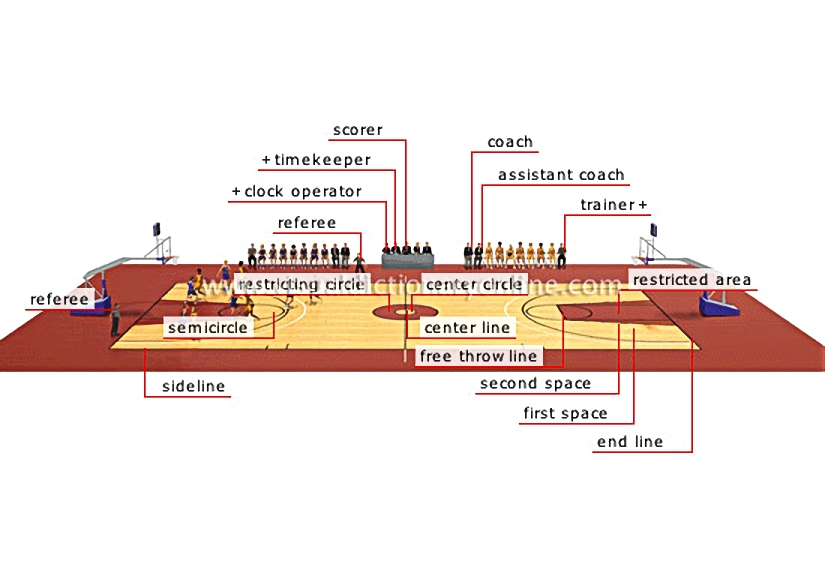
court 						Circle around the center circle; players not taking part in the tip-off must be outside this circle.				  							Official who keeps time; this individual stops the clock when play stops and starts it again when play resumes.				  							Official who keeps track of a team’s possession time.				  							Official who records points and fouls committed by the players.				  							Circle at center court used for tip-offs at the start of a half and after a goal; a tip-off is when two players jump for the ball and try to push it toward their teammates.				  							Line along the sides of the court; when the ball crosses this line, it is put back into play at the same place.				  							Official who assists the first referee and also stays at the perimeter of the court so as not to interfere with the players.				  							Line dividing the court into two halves, one for each team.				  							Official responsible for applying the rules; this individual does tip-offs and signals fouls.				  							Semicircular zone where the player takes position to make a free throw, which is worth one point.				  							Individual who treats injured players.				  							Person who assists the coach and can replace the coach if needed.				  							The team’s leader; the coach plots strategy and decides who plays in different situations.				  							Line parallel to the end line; the shooter stands behind it for a free throw (throw awarded after a foul).				  							Space along the restricted area near the free throw line; one of the shooter’s teammates is in this space when there is a free throw.				  							Space along the restricted area near the end line; one of the opposing players is in this space when there is a free throw.				  							Line marking the ends of the court; when the ball crosses this line, one team puts it back into play at the same place.				  							A trapezoidal area between the end line and the free throw line; an attacking player is not allowed to stay in it for more than three seconds.
restricting circle

Circle around the center circle; players not taking part in the tip-off must be outside this circle.

timekeeper

Official who keeps time; this individual stops the clock when play stops and starts it again when play resumes.

clock operator

Official who keeps track of a team’s possession time.

scorer

Official who records points and fouls committed by the players.

center circle

Circle at center court used for tip-offs at the start of a half and after a goal; a tip-off is when two players jump for the ball and try to push it toward their teammates.

sideline

Line along the sides of the court; when the ball crosses this line, it is put back into play at the same place.

referee

Official who assists the first referee and also stays at the perimeter of the court so as not to interfere with the players.

center line

Line dividing the court into two halves, one for each team.

referee

Official responsible for applying the rules; this individual does tip-offs and signals fouls.

semicircle

Semicircular zone where the player takes position to make a free throw, which is worth one point.

trainer

Individual who treats injured players.

assistant coach

Person who assists the coach and can replace the coach if needed.

coach

The team’s leader; the coach plots strategy and decides who plays in different situations.

free throw line

Line parallel to the end line; the shooter stands behind it for a free throw (throw awarded after a foul).

second space

Space along the restricted area near the free throw line; one of the shooter’s teammates is in this space when there is a free throw.

first space

Space along the restricted area near the end line; one of the opposing players is in this space when there is a free throw.

end line

Line marking the ends of the court; when the ball crosses this line, one team puts it back into play at the same place.

restricted area

A trapezoidal area between the end line and the free throw line; an attacking player is not allowed to stay in it for more than three seconds.