competitive course
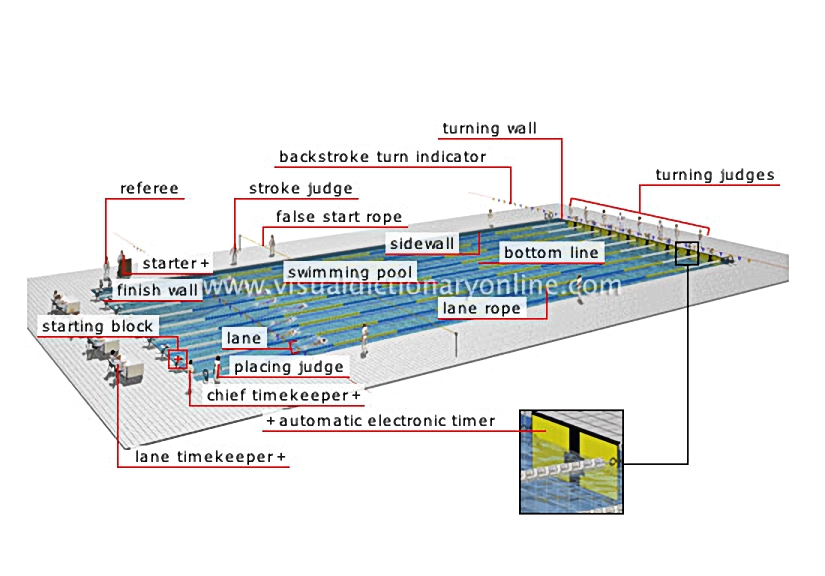
The events, for singles and teams, take place in a pool that is 25 m or 50 m (Olympic-sized pool) long.
false start rope
Rope that is 50 ft from the wall; it is dropped into the water in the event of a false start to inform the swimmers that they must resume their starting positions.
finish wall
Wall that the swimmer must touch to end a race; it is also the wall for turning around during events longer than 100 m in an Olympic-sized pool.
starter
Official who gives the start signal; false starts lead to the disqualification of the swimmer in error.
lane timekeeper
Official who manually registers the finish time of the competitor swimming in an assigned lane.
chief timekeeper
Official who collects the times registered by the lane timekeepers; these data are used in the event the electronic timer fails.
placing judge
Official who confirms the times registered by the electronic timer after checking with the timekeepers.
starting block
Metal elevated structure from which the swimmer dives into the pool to start a race.
referee
Official who enforces the rules and oversees the progress of the competition; the referee ratifies the judges’ decisions and resolves any disputes that may arise.
stroke judge
Each of the four officials checking the acceptability of the swimmers’ movements, depending on the stroke category.
lane
The strips, numbered from 1 to 8, that are reserved for swimmers during a race; swimmers must stay in the same lane throughout the event.
turning wall
Wall that the swimmer must touch before turning around; during the turn, the athlete pushes from the wall with the feet.
backstroke turn indicator
Rope with pennants that is strung 16 ft from the finish and turning walls; backstroke swimmers use it to judge distance.
lane rope
Cord with floaters along it that delimits the eight lanes of the pool; it is designed to reduce turbulence on the surface of the water.
bottom line
Continuous line on the bottom of the pool in the center of each lane; it is a visual guide for the swimmer.
sidewall
Wall forming the side of the pool; there is at least 20 in between the side wall and the outside lane ropes.
swimming pool
Pool where swimming competitions take place; the water in it is maintained at a constant temperature (around 78°F) and depth.
turning judges
Officials checking the validity of the turns; in the 800 m and 1500 m events, they inform the swimmers of how many lengths they have left to do.
automatic electronic timer
Apparatus for automatically registering the swimmer’s finish time; it is activated at the start and stops when the swimmer comes into contact with the wall.
![examples-dives [2]](../../../images/flechePrevious.gif "examples-dives [2] image") previous
previous


