course
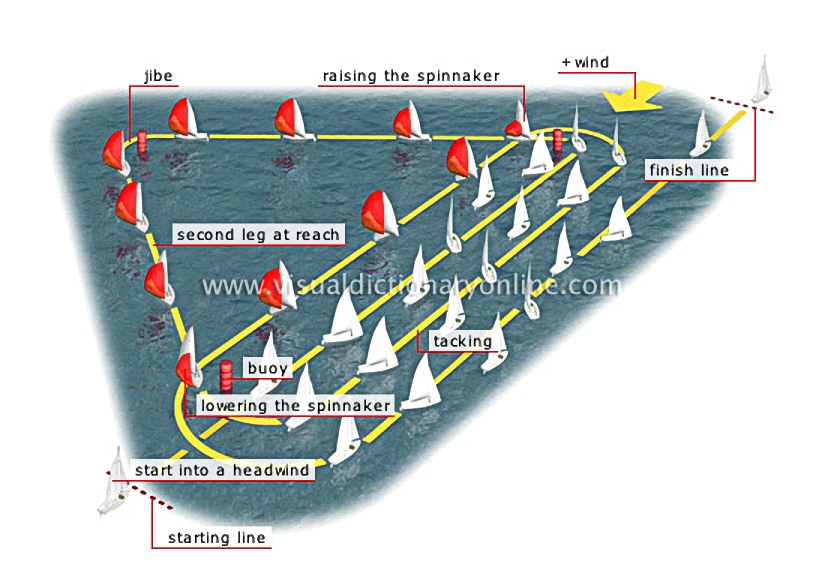
Olympic events take place on a triangular course whose length varies depending on variables such as the characteristics of the water and the wind direction.
tacking
Technique of navigating in a zigzag course when sailing upwind; the sails cross from one side of the boat to the other.
second leg at reach
The sailboat first navigates the beam reach with the wind on the starboard side until the third buoy (first leg at reach), then sails a second straight line to the beam reach with the wind on the port side.
lowering the spinnaker
The crew lowers the spinnaker when the sailboat turns into the wind, after the second leg at reach.
starting line
Line marking the beginning of the race; when the starting signal is given, all the sailboats must be behind this line.
buoy
Floating object that marks out the race. An Olympic-type race has three buoys that are arranged in a triangle; they are rounded in a specific order.
start into a headwind
The race begins facing upwind; sailboats must then tack until the second buoy, which is located straight ahead.
finish line
Line marking the end of the race; events are usually made up of several sets, the combined result of which determines the winner.
wind
Displacement of air caused by variations in pressure between two regions of the atmosphere.
raising the spinnaker
When the sailboat navigates points of sailing (with the wind almost from behind), the crew increases speed by hoisting a large lightweight sail called a spinnaker over the bow.
jibe
Technique for changing the sailboat’s course when the wind is coming from the rear by letting the sails cross from one side of the boat to the other.
 previous

