HOME
::
SPORTS & GAMES
::
AERIAL SPORTS
::
HANG GLIDING
::
HANG GLIDER
hang glider
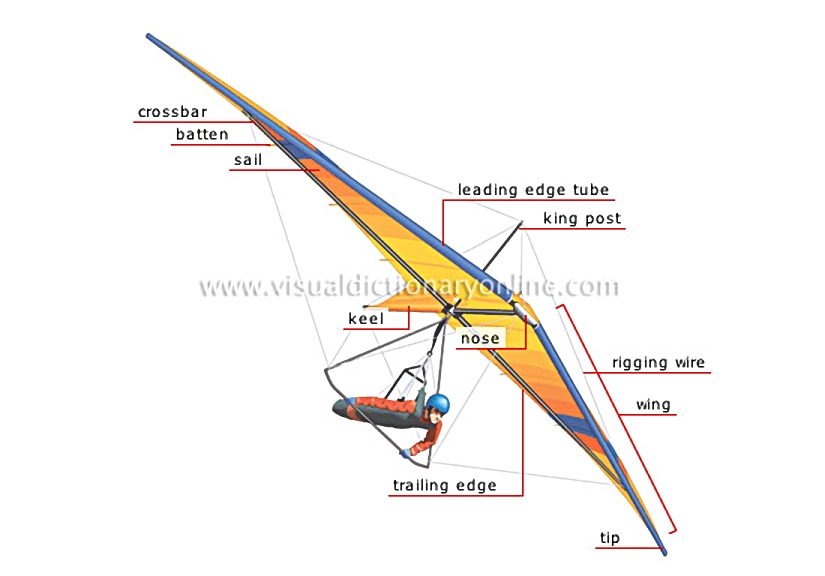
Equipment made up of two wings connected to a harness; it is used to take off from a height and gain altitude on lifting air currents.
previous
next
king post
Vertical piece attached at the center of the keel; it supports the rigging wires.
trailing edge
Back edge of the sail.
crossbar
Metal tube that is perpendicular to the keel and attached at the center of the two wings; it keeps the sail deployed.
sail
Triangular surface made up of pieces of fabric; it is stretched over a metal skeleton to form a wing.
batten
Stiff strip inserted into batten pockets on the sail to help it retain its shape.
leading edge tube
One of two metal tubes running along the front edge of the sail to keep it taut.
keel
Metal tube attached longitudinally to the intersection of the two wings; it supports the leading edge tubes and keeps the sail taut.
wing
Horizontal surface that is acted upon by aerodynamic forces to keep the hang glider aloft.
tip
Outermost portion of the wing; it forms a point.
nose
Forward end of the hang glider where the two leading edge tubes meet.
rigging wire
One of the cables stretching from the king post to the wing structure; they increase resistance to tension.

 previous