cockpit

Compartment where the glider pilot sits among all the instruments necessary to pilot the aircraft and control flight.
cockpit 						Apparatus that sends and receives signals to communicate with another glider or with a ground station.				  							Lever that maintains the position of the control stick to reduce pilot fatigue.				  							Lever used to raise and lower the air brakes.				  							Foot lever that the pilot presses down to control rudder movement.				  							Lever used to release the tow cable connecting the glider to the tow plane that brings it aloft.				  							Device that indicates the glider’s vertical rate of climb or descent by mechanical means.				  							Device that indicates the glider’s vertical rate of climb or descent by means of an electric sensor; it is more accurate than a mechanical variometer.				  							Device indicating the speed of the glider with respect to the air through which it is moving.				  							Device that controls the opening and closing of air vents to provide air circulation within the cockpit.				  							Place where the pilot sits to maneuver the glider; the pilot is strapped into the seat and wears a mandatory reserve parachute.				  							Lever used to control the ailerons and the elevator.				  							Lever that detaches the cockpit canopy from the fuselage so the pilot can eject in case of emergency.				  							Device that converts electric pulses into broadcast or recorded sounds.				  							Device used to activate the system that provides the pilot with oxygen when the glider climbs to high altitudes.				  							Device used to regulate the pilot’s oxygen flow.				  							Instrument with a gyroscope connected to a pointer that indicates the rate and direction of turning; it also has a ball that shows if the glider is rolling sideways.				  							Navigation instrument that indicates the glider’s direction with respect to magnetic north.				  							Device indicating the glider’s altitude.

radio

Apparatus that sends and receives signals to communicate with another glider or with a ground station.

turn and slip knob

Lever that maintains the position of the control stick to reduce pilot fatigue.

air brake handle

Lever used to raise and lower the air brakes.

rudder pedal

Foot lever that the pilot presses down to control rudder movement.

tow release knob

Lever used to release the tow cable connecting the glider to the tow plane that brings it aloft.

mechanical variometer

Device that indicates the glider’s vertical rate of climb or descent by mechanical means.

electric variometer

Device that indicates the glider’s vertical rate of climb or descent by means of an electric sensor; it is more accurate than a mechanical variometer.

airspeed indicator

Device indicating the speed of the glider with respect to the air through which it is moving.

cockpit ventilation

Device that controls the opening and closing of air vents to provide air circulation within the cockpit.

seat

Place where the pilot sits to maneuver the glider; the pilot is strapped into the seat and wears a mandatory reserve parachute.

control stick

Lever used to control the ailerons and the elevator.

canopy release knob

Lever that detaches the cockpit canopy from the fuselage so the pilot can eject in case of emergency.

microphone

Device that converts electric pulses into broadcast or recorded sounds.

oxygen feeding knob

Device used to activate the system that provides the pilot with oxygen when the glider climbs to high altitudes.

oxygen feeding control

Device used to regulate the pilot’s oxygen flow.

turn and slip indicator

Instrument with a gyroscope connected to a pointer that indicates the rate and direction of turning; it also has a ball that shows if the glider is rolling sideways.

compass

Navigation instrument that indicates the glider’s direction with respect to magnetic north.
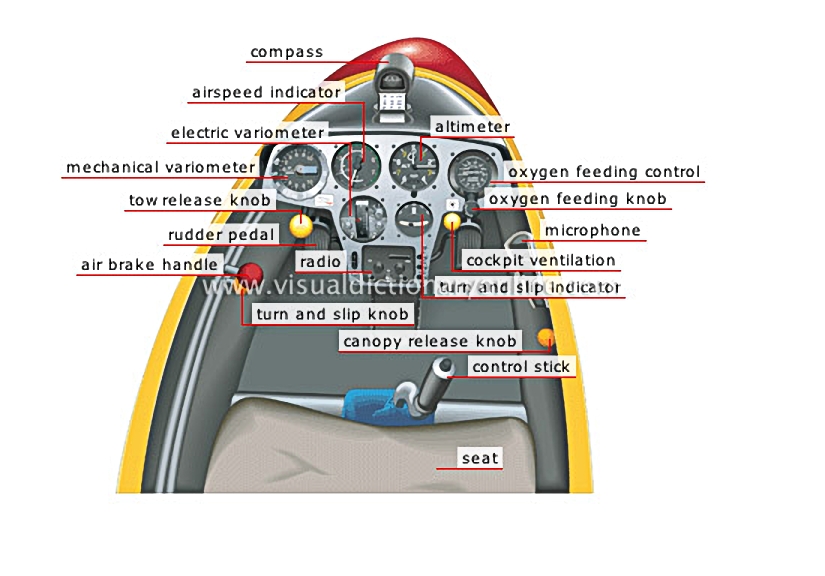
altimeter

Device indicating the glider’s altitude.