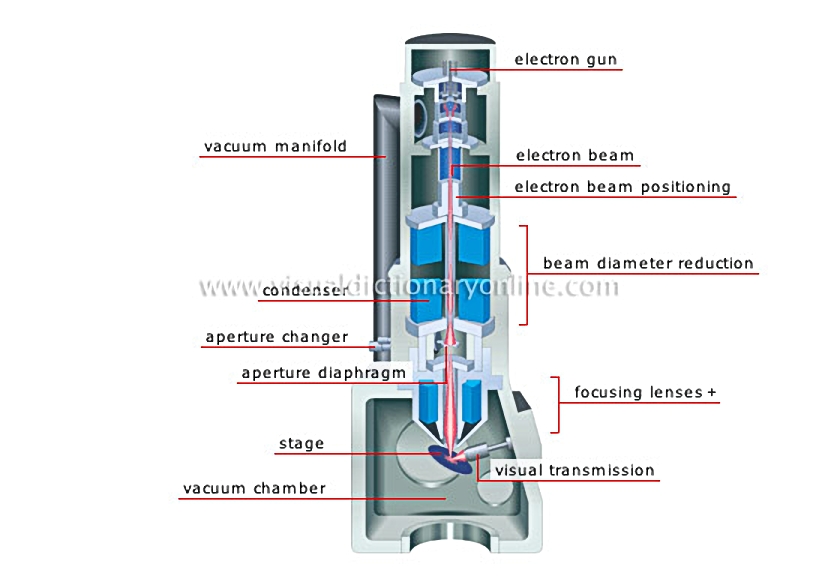
cross section of an electron microscope
Electron microscope: it uses an electron beam (as opposed to light) to provide magnification that is markedly superior to that of an optical microscope.
stage
Adjustable metal plate (stage) on which the specimen is mounted in order to study it.
aperture diaphragm
Device with an opening whose diameter can be changed to narrow or widen the diameter of the electron beam.
aperture changer
Device that adjusts the diaphragm opening in order to change the diameter of the beam.
condenser
System of magnetic lenses (electromagnets producing a magnetic field when excited by an electric current) that concentrates the beam onto the specimen under study.
vacuum manifold
Conduit connected to a pump that creates enough of a vacuum in the microscope that it can function.
electron gun
Device that usually consists of a tungsten filament that is heated to produce an intense electron beam, which illuminates the specimen.
vacuum chamber
Part of the microscope in which pressure can be reduced so that the electrons can move.
visual transmission
The electron beam explores the surface of the specimen, which in turn emits electrons to form a point-by-point image on the screen.
focusing lenses
System of magnetic lenses (electromagnets) that concentrate the electron beam on one spot on the specimen.
beam diameter reduction
The two lenses of the condenser cause the divergent electron beam emitted by the gun to converge.
electron beam positioning
Control that positions the electron beam along the optical axis so that it reaches the specimen.
electron beam
Set of negatively charged particles that propagate toward the specimen.
 previous