HOME
::
SCIENCE
::
PHYSICS: OPTICS
::
MAGNIFYING GLASS AND MICROSCOPES
::
BINOCULAR MICROSCOPE
binocular microscope
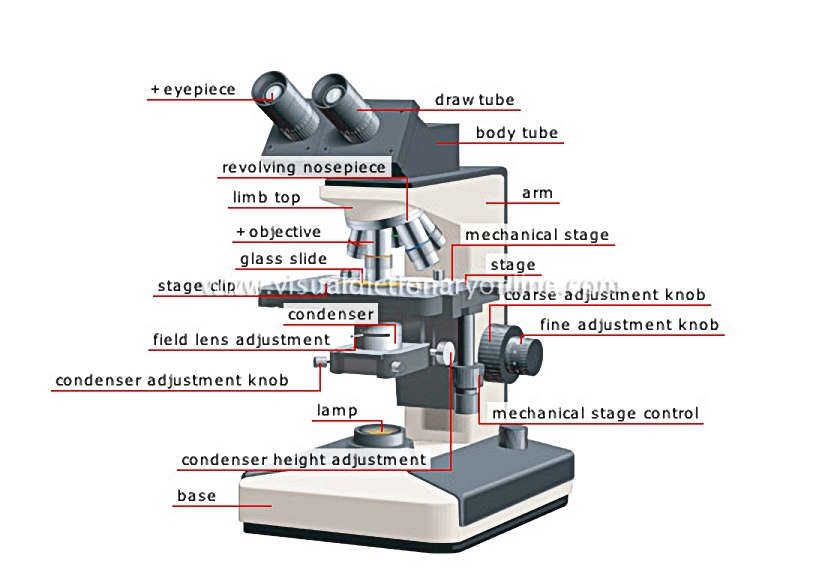
Its two eyepieces allow both eyes to be fully applied; this provides a degree of depth to the image and prevents eyestrain.
previous
next
coarse adjustment knob
Medium-precision focusing device for adjusting the distance between the objective and the object under study.
body tube
Metal casing that houses the microscope’s two eyepieces and through which light rays pass.
revolving nosepiece
Rotating plate to which objectives of different powers are fixed to allow them to be used in succession during a study.
arm
Vertical part of the microscope that supports the components (draw tube, stage) and contains the focusing mechanisms.
mechanical stage
Adjustable part with two guiding screws that moves an object from right to left and from front to back on the stage.
stage
Metal plate with an opening in the middle; the glass slide and the components keeping it in place are placed on it.
fine adjustment knob
High-precision focusing device for adjusting the distance between the objective and the object under study.
mechanical stage control
Device for raising and lowering the mechanical stage.
condenser height adjustment
Screw for raising and lowering the condenser.
condenser
Optical system that usually has two lenses to concentrate the light emitted from the lamp onto the object under study.
lamp
Electric device that produces a light beam to illuminate the object under study.
base
Support that stabilizes the microscope.
condenser adjustment knob
Screw that centers the condenser’s light beam in the field of vision by moving it along a horizontal plane.
field lens adjustment
Device with a variable-diameter opening that adjusts the amount of light illuminating the object.
glass slide
Fine glass plate on which the object to be studied is placed.
stage clip
Springlike metal blade that keeps the glass slide on the stage.
objective
Lens system that captures the light from the observed object and makes it converge to form an enlarged inverted image.
limb top
Upper part of the arm that supports the revolving nosepiece.
eyepiece
System of lenses that acts as a magnifier; the eye looks through it to see an enlarged image of the image produced by the objective.
draw tube
One of two cylindrical tubes that house the eyepieces; it is often made up of two converging lenses.

 previous