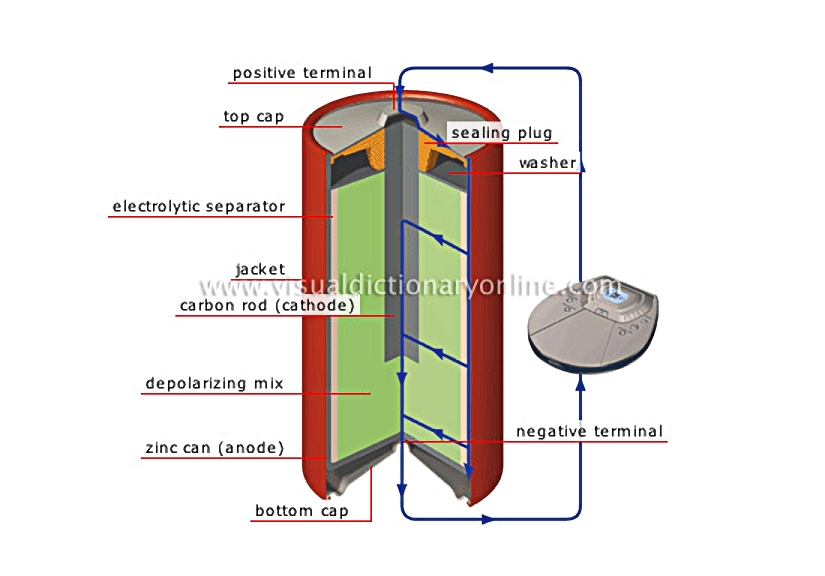
carbon-zinc cell
Battery that produces 1.5 V (also called Leclanché); its use is very widespread (pocket calculators, portable radios, alarm clocks).
positive terminal
Polarity element of the battery from which the current flows.
electrolytic separator
Porous paper combined with a chemical paste (ammonium chloride) that separates the two electrodes; this allows electrons to pass, thus conducting electricity.
carbon rod (cathode)
Carbon rod set in the depolarizing mix; it constitutes the battery’s negative electrode (cathode) collecting the electrons returning from the circuit.
depolarizing mix
Mixture of carbon and manganese dioxide that augments conductivity by acting as a barrier to polarization.
zinc can (anode)
Zinc receptacle that constitutes the battery’s positive electrode (anode).
bottom cap
Lower metal cover; the negative terminal is located at its center.
negative terminal
Polarity element of the battery toward which the current flows.
 previous
