weight-driven clock mechanism

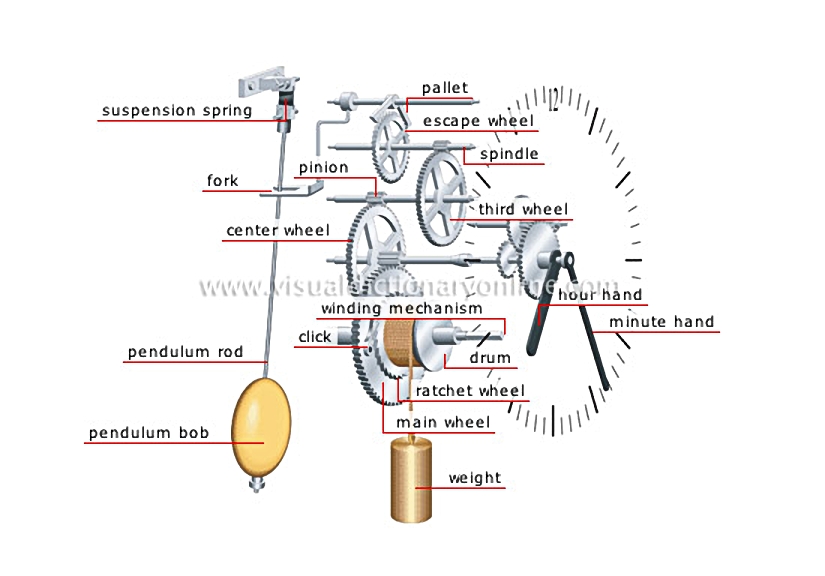
This clock is operated by weights that, under gravity, drive the hands of the clock in their rotational movement by means of a gear train.
weight-driven clock mechanism 						Cylinder around which the weights’ cord or chain winds when the clock is rewound.				  							Heavy body that hangs from the main wheel; its descent provides the necessary energy for the clock’s mechanism.				  							Toothed wheel having only one direction of rotation; it is kept in place by the click.				  							First wheel in the gear train that transmits the driving force of the weights to the other wheels to turn them.				  							Weight attached to the end of the pendulum rod.				  							Small lever that is engaged between the ratchet-wheel teeth and prevents it from rotating counter to its normal direction.				  							Rigid bar to which the pendulum bob is attached.				  							Wheel that is connected to the hands and causes them to rotate on the dial.				  							Part that is operated by the escape wheel to cause the pendulum’s movement.				  							Small wheel with teeth that is mounted on a shaft and transmits the rotational movement of one wheel to another.				  							Small rigid plate from which the pendulum hangs.				  							Anchor-shaped part that frees and constrains the escape wheel’s teeth to maintain the pendulum’s back-and-forth movement.				  							Device that raises the weights to start anew the cycle of the clock’s mechanism.				  							Metal needle that points at the 24 hours of a day on the dial.				  							Metal needle that points at the 60 minutes of an hour on the dial.				  							Wheel that receives energy from the center wheel and drives the escape wheel.				  							Cylindrical part that transfers the rotational movement of one part to another.				  							Last wheel of the gear train with special teeth that causes the clock to operate regularly and continuously and controls the movement of the other wheels.

See Also


grandfather clock

drum

Cylinder around which the weights’ cord or chain winds when the clock is rewound.

weight

Heavy body that hangs from the main wheel; its descent provides the necessary energy for the clock’s mechanism.

ratchet wheel

Toothed wheel having only one direction of rotation; it is kept in place by the click.

main wheel

First wheel in the gear train that transmits the driving force of the weights to the other wheels to turn them.

pendulum bob

Weight attached to the end of the pendulum rod.

click

Small lever that is engaged between the ratchet-wheel teeth and prevents it from rotating counter to its normal direction.

pendulum rod

Rigid bar to which the pendulum bob is attached.

center wheel

Wheel that is connected to the hands and causes them to rotate on the dial.

fork

Part that is operated by the escape wheel to cause the pendulum’s movement.

pinion

Small wheel with teeth that is mounted on a shaft and transmits the rotational movement of one wheel to another.

suspension spring

Small rigid plate from which the pendulum hangs.

pallet

Anchor-shaped part that frees and constrains the escape wheel’s teeth to maintain the pendulum’s back-and-forth movement.

winding mechanism

Device that raises the weights to start anew the cycle of the clock’s mechanism.

hour hand

Metal needle that points at the 24 hours of a day on the dial.

minute hand

Metal needle that points at the 60 minutes of an hour on the dial.

third wheel

Wheel that receives energy from the center wheel and drives the escape wheel.

spindle

Cylindrical part that transfers the rotational movement of one part to another.

escape wheel

Last wheel of the gear train with special teeth that causes the clock to operate regularly and continuously and controls the movement of the other wheels.