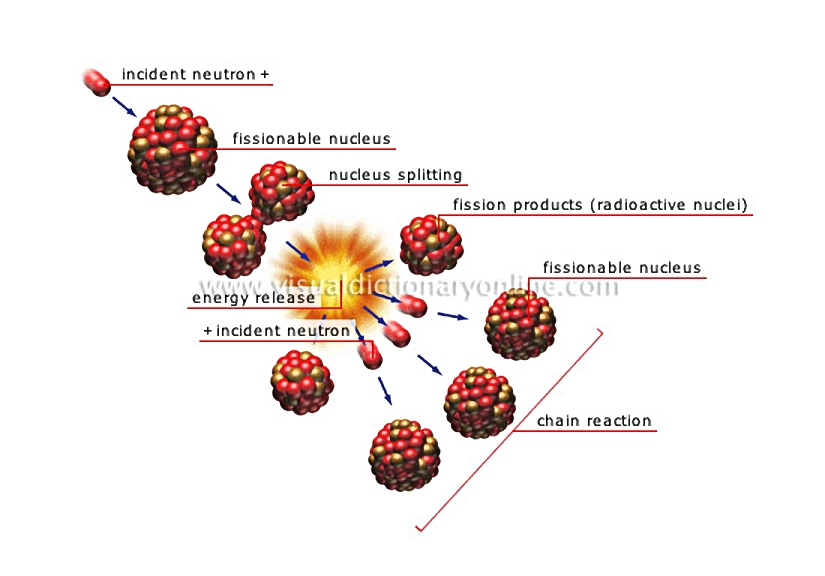
nuclear fission
Process by which the atoms’ nuclei become fragmented (e.g., in a nuclear reactor); neutrons are released and energy is produced in the form of heat.
chain reaction
During nuclear fission, parts of the atom’s nucleus that have been broken off by collision with the neutron will in turn bombard other nuclei to produce more fission.
fissionable nucleus
Only heavy nuclei, such as those of uranium and plutonium, can undergo fission following a collision with a neutron.
fission products (radioactive nuclei)
The nuclei of unstable atoms produced by fission emit rays that can be harmful to living organisms.
energy release
Nuclear fission is accompanied by a very large release of energy, which is derived from the forces that caused the nucleus’s cohesion.
nucleus splitting
When the atom’s nucleus is bombarded by a neutron, it absorbs it and becomes unstable; it then divides into two smaller nuclei usually of identical size.
fissionable nucleus
Only heavy nuclei, such as those of uranium and plutonium, can undergo fission following a collision with a neutron.
incident neutron
The fission of a nucleus releases two or three neutrons, which in turn bombard other nuclei and divide them.
incident neutron
A free neutron comes into collision with an atom’s nucleus, which it then splits.
 previous
