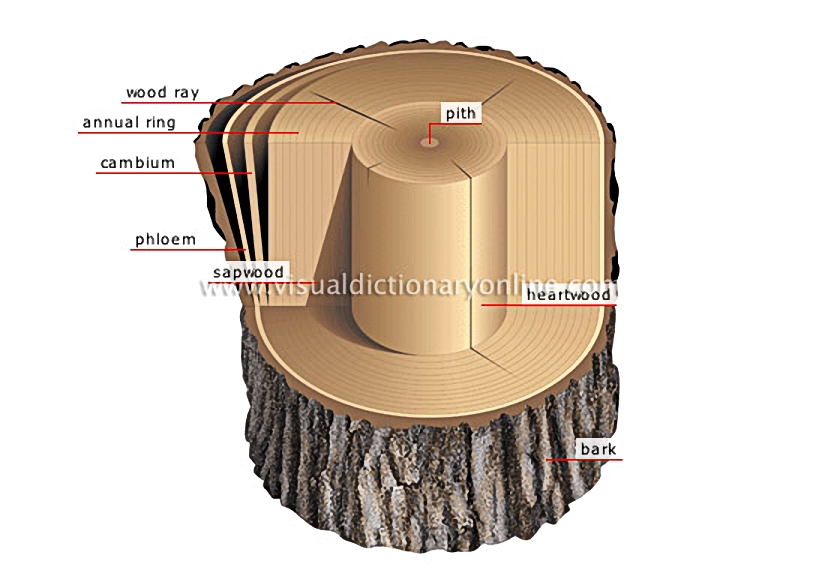
cross section of a trunk
Moving from the center to the periphery there are six parts: the pith, the heartwood, the sapwood, the cambium, the phloem and the bark.
heartwood
Hard dark-colored wood layer made of dead sapwood; it encircles the pith and supports the trunk and branches.
pith
Central part of the trunk, composed of soft tissue that contains nutrients essential for sapling growth.
bark
Tree’s external protective layer; its texture and color vary depending on the species.
phloem
Tissue located immediately below the bark, whose main function is to transport sap transformed by photosynthesis from the leaves throughout the rest of the tree.
cambium
Growth tissue that simultaneously produces the external phloem and the internal sapwood, thereby enabling the tree to increase in diameter.
sapwood
Relatively new layer of wood that is generally pale in color; it transports raw sap, composed of water and nutrient minerals, from the roots to the leaves.
annual ring
Each of the concentric circles representing the layer of wood produced in one year; the age of the tree can be determined by the number of rings.
wood ray
Conduit connecting the pith to the core and circulating nutrients horizontally within the trunk.
 previous

