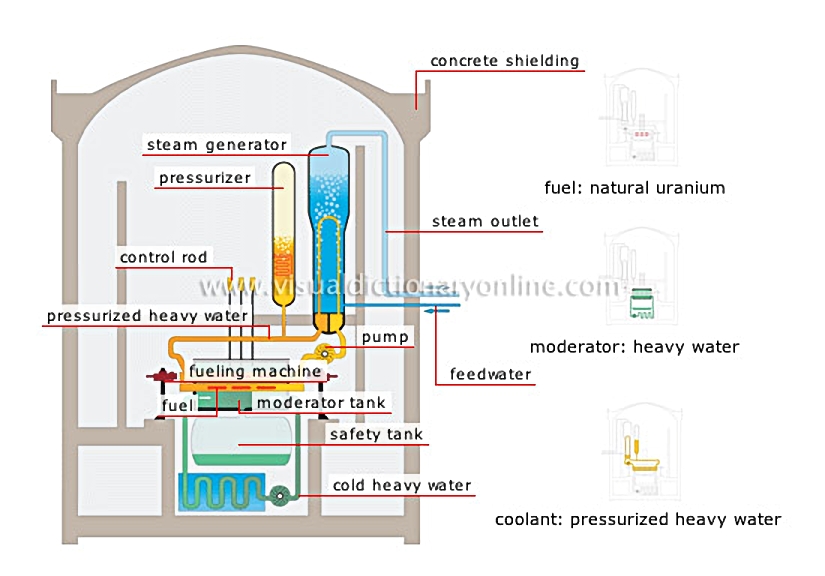
heavy-water reactor
The advantage of this type of reactor is that it does not require fuel enrichment; it is used mainly in Canada, Argentina and India.
concrete shielding
Concrete structure that holds back radioactive products in the event of an accident.
pressurized heavy water
Heavy water that is heated in the reactor core is kept under pressure to prevent it from boiling.
steam generator
Device that uses heat from the coolant to turn water into steam to activate the turbine.
pressurizer
Device that keeps the coolant water at a preset temperature to prevent it from boiling.
steam outlet
Steam from the generator is carried to the turbine and generator to produce electricity.
feedwater
Piping carries water from the condenser to the steam generator, where it is turned into steam.
fueling machine
Remote-controlled device that inserts new fuel into the reactor.
control rod
Tube that contains a neutron-absorbing material (boron, cadmium) that is introduced into the reactor core to control its power.
pump
Apparatus that circulates the coolant fluid between the reactor and the steam generator.
safety tank
Tank where cold heavy water from the moderator flows to stop fission reactions in the event of an emergency.
cold heavy water
A pumping system ensures that heavy water around the moderator tank circulates, cools and is purified.
fuel
Matter that is placed in the reactor core; it contains heavy atoms (uranium, plutonium) from which power is extracted by fission.
moderator tank
Steel tank that contains cold heavy water from the moderator.
moderator: heavy water
Heavy water: water consisting of heavy hydrogen (deuterium) and oxygen; it can slow down neutrons.
coolant: pressurized heavy water
Heavy water is kept at a set pressure to prevent it from boiling.
fuel: natural uranium
Natural uranium: fuel extracted from mines; it consists of a mixture of three uranium isotopes (uranium-234, -235 and -238).
 previous
