runners

Movable parts of the turbine that transmit the movement of the water to the shaft to which they are attached to turn the rotor.
runners 						Disk housing all the turbine buckets that activates the runner.				  							Type of runner that is suited to high water sources (usually over 1,000 ft) and low flow rates.				  							Element made up of a nut and a bolt that attaches the runner to the shaft plate to transmit its movement to the runner.												Small bucket that is attached to the turbine’s runner; water enters it to turn the wheel.				  							Type of runner that is suited to low heights of water (usually between 30 and 200 ft) and variable flow rates.				  							Movable part that is fixed to the hub of the runner; it turns through the action of water power on it.				  							Cover for the lower cone-shaped part of the hub.				  							Part of the runner that holds the shaft; the runner blades are attached to it.				  							Most common type of runner that is suited to average heights of water (usually between 100 and 1,000 ft).				  							Stationary curved plate on the turbine’s runner; it receives the thrust of the water to turn the runner.				  							Circular part that supports the wicket gates.

See Also


nuts

bolt

hydraulic turbine

bucket ring

Disk housing all the turbine buckets that activates the runner.

Pelton runner

Type of runner that is suited to high water sources (usually over 1,000 ft) and low flow rates.

coupling bolt

Element made up of a nut and a bolt that attaches the runner to the shaft plate to transmit its movement to the runner.
nuts
nuts
bolt
bolt

bucket

Small bucket that is attached to the turbine’s runner; water enters it to turn the wheel.

Kaplan runner

Type of runner that is suited to low heights of water (usually between 30 and 200 ft) and variable flow rates.

runner blade

Movable part that is fixed to the hub of the runner; it turns through the action of water power on it.

hub cover

Cover for the lower cone-shaped part of the hub.

hub

Part of the runner that holds the shaft; the runner blades are attached to it.

Francis runner

Most common type of runner that is suited to average heights of water (usually between 100 and 1,000 ft).

blade

Stationary curved plate on the turbine’s runner; it receives the thrust of the water to turn the runner.
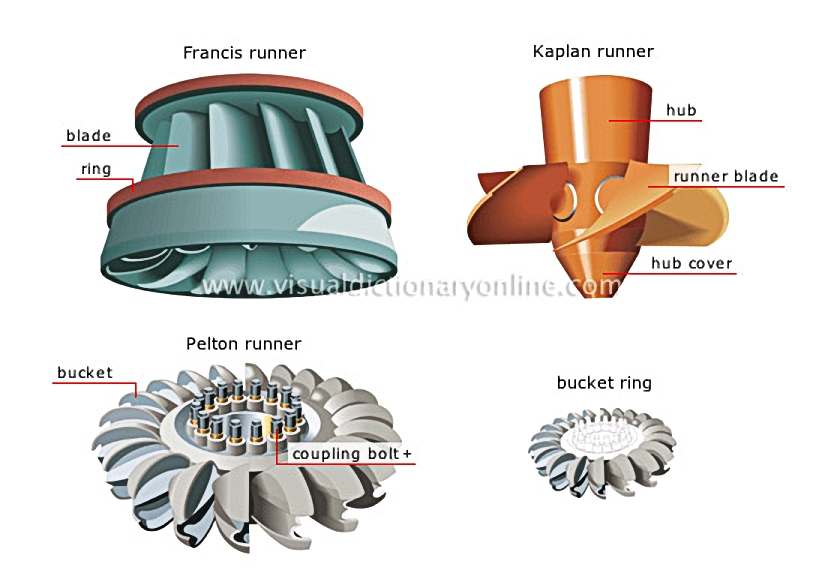
ring

Circular part that supports the wicket gates.