embankment dam

Formed of mounds of earth or rocks, it is used mainly when the subsoil does not allow for construction of a concrete dam.
embankment dam 				  							Layer of permeable materials that is inserted into large-scale dams to collect infiltrated water.				  							Granular material that is inserted between the core and the shoulder; it filters particles carried by the water flow to prevent erosion.				  							Area of the foundation of the dam that is connected to the core; it contains impermeable materials to limit leakage and infiltration under the dam.				  							Impermeable layer that consists of compact clay; it rests on the bottom of the dam to prevent infiltration.				  							Natural terrain (such as rock, sand or clay) on which the dam is built.				  							Soil embankment that, together with the upstream shoulder, provides stability to the structure.				  							Layer of permeable materials on the foundation of the dam; it collects infiltrated water and prevents erosion of the base of the dam.				  							Soil embankment located on the reservoir side; its mass provides stability to the dam.				  							Area where the upstream shoulder and the foundation of the dam meet.				  							Area where the downstream shoulder and the foundation of the dam meet.				  							Horizontal ledge that stabilizes the upstream or downstream shoulder.				  							Basin formed by the construction of a dam; it holds back a very large volume of water so that the flow rate can be controlled.				  							Small wall located at the top of the upstream shoulder that protects the dam against waves.				  							Layer of rock or concrete blocks that covers the upstream shoulder to prevent erosion.				  							Central portion of the dam that is usually made of compact clay to make it watertight.				  							Upper part of the dam; it rises above the water level of the reservoir by several yards.
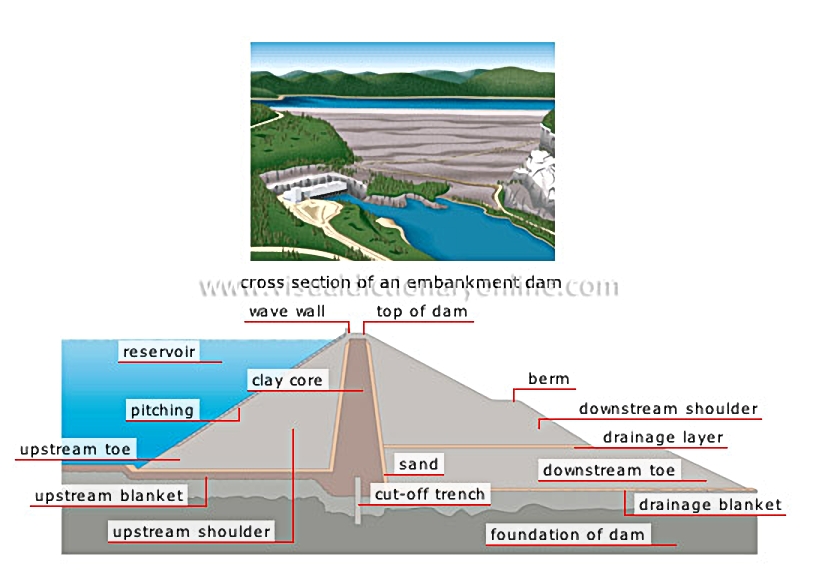
cross section of an embankment dam

drainage layer

Layer of permeable materials that is inserted into large-scale dams to collect infiltrated water.

sand

Granular material that is inserted between the core and the shoulder; it filters particles carried by the water flow to prevent erosion.

cut-off trench

Area of the foundation of the dam that is connected to the core; it contains impermeable materials to limit leakage and infiltration under the dam.

upstream blanket

Impermeable layer that consists of compact clay; it rests on the bottom of the dam to prevent infiltration.

foundation of dam

Natural terrain (such as rock, sand or clay) on which the dam is built.

downstream shoulder

Soil embankment that, together with the upstream shoulder, provides stability to the structure.

drainage blanket

Layer of permeable materials on the foundation of the dam; it collects infiltrated water and prevents erosion of the base of the dam.

upstream shoulder

Soil embankment located on the reservoir side; its mass provides stability to the dam.

upstream toe

Area where the upstream shoulder and the foundation of the dam meet.

downstream toe

Area where the downstream shoulder and the foundation of the dam meet.

berm

Horizontal ledge that stabilizes the upstream or downstream shoulder.

reservoir

Basin formed by the construction of a dam; it holds back a very large volume of water so that the flow rate can be controlled.

wave wall

Small wall located at the top of the upstream shoulder that protects the dam against waves.

pitching

Layer of rock or concrete blocks that covers the upstream shoulder to prevent erosion.

clay core

Central portion of the dam that is usually made of compact clay to make it watertight.

top of dam

Upper part of the dam; it rises above the water level of the reservoir by several yards.