underground mine

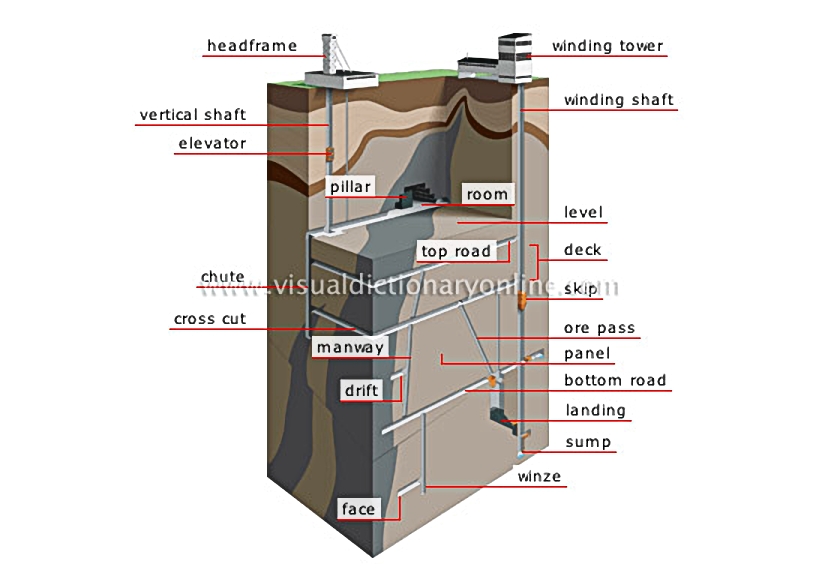
Property in which excavations are carried out to extract deeply embedded (between 30 and 11,500 ft) coal for industrial mining.
underground mine 						Power lift fitted with a cab that transports coal or miners between the various levels.				  							Cavity that remains after the ore is extracted; pillars support its roof.				  							Bottom of the shaft in which water runoff accumulates inside the mine before being pumped to the surface.				  							Extraction layer between two levels; mining is usually done in stages and in descending order.				  							The horizontal passageways that branch off from the shaft at the same depth; they are usually at regular intervals.				  							Passageway dug horizontally along the grade line of the ore seam; it can also be dug into the ore vertically.				  							Opening that is dug laterally into the rock as coal is extracted.				  							Horizontal passageway that cuts through the ore bed perpendicularly; it provides communication between the passageways and helps to ventilate the mine.				  							Vertical or inclined passageway through which ore, equipment, personnel and air move from one level of the mine to the other.				  							Vertical or inclined passageway that connects two levels; it is dug downward from inside the mine and not from the surface.				  							Passageway allowing workers to move around in the mine.				  							Landing located around a shaft on each level; coal is collected here before being moved to the surface.				  							Unit of rock that is being mined; it is contained between vertical and horizontal planes and is demarcated by various passageways.				  							Inclined route that takes coal to a lower level; coal that falls on the mine floor is usually crushed before being brought to the surface.				  							Elevator consisting of a skip bucket that is activated by a hoist; it is used to bring coal and people to the surface.				  							Horizontal passageway that serves the highest level of a panel.				  							Mass of ore that is left unmined at regular intervals in an excavation (chamber); it provides stability for the upper layers.				  							Shaft that is dug vertically into the ground; coal is removed from the mine through it using hoisting machinery.				  							Building that houses the shaft’s hoisting equipment (including motors and hoisting cables); it provides communication between the surface and the mine galleries.				  							Shaft that is dug perpendicular to the surface; it serves various levels and is used mainly to transport personnel, equipment and ore.				  							Horizontal passageway that serves the base of a panel.				  							Opening at the top of the shaft that connects the aboveground facilities (including ventilation fans and hoists) to the underground areas being mined.
See Also


pithead

elevator

Power lift fitted with a cab that transports coal or miners between the various levels.

room

Cavity that remains after the ore is extracted; pillars support its roof.

sump

Bottom of the shaft in which water runoff accumulates inside the mine before being pumped to the surface.

deck

Extraction layer between two levels; mining is usually done in stages and in descending order.

level

The horizontal passageways that branch off from the shaft at the same depth; they are usually at regular intervals.

drift

Passageway dug horizontally along the grade line of the ore seam; it can also be dug into the ore vertically.

face

Opening that is dug laterally into the rock as coal is extracted.

cross cut

Horizontal passageway that cuts through the ore bed perpendicularly; it provides communication between the passageways and helps to ventilate the mine.

chute

Vertical or inclined passageway through which ore, equipment, personnel and air move from one level of the mine to the other.

winze

Vertical or inclined passageway that connects two levels; it is dug downward from inside the mine and not from the surface.

manway

Passageway allowing workers to move around in the mine.

landing

Landing located around a shaft on each level; coal is collected here before being moved to the surface.

panel

Unit of rock that is being mined; it is contained between vertical and horizontal planes and is demarcated by various passageways.

ore pass

Inclined route that takes coal to a lower level; coal that falls on the mine floor is usually crushed before being brought to the surface.

skip

Elevator consisting of a skip bucket that is activated by a hoist; it is used to bring coal and people to the surface.

top road

Horizontal passageway that serves the highest level of a panel.

pillar

Mass of ore that is left unmined at regular intervals in an excavation (chamber); it provides stability for the upper layers.

winding shaft

Shaft that is dug vertically into the ground; coal is removed from the mine through it using hoisting machinery.

winding tower

Building that houses the shaft’s hoisting equipment (including motors and hoisting cables); it provides communication between the surface and the mine galleries.

vertical shaft

Shaft that is dug perpendicular to the surface; it serves various levels and is used mainly to transport personnel, equipment and ore.

bottom road

Horizontal passageway that serves the base of a panel.

headframe

Opening at the top of the shaft that connects the aboveground facilities (including ventilation fans and hoists) to the underground areas being mined.