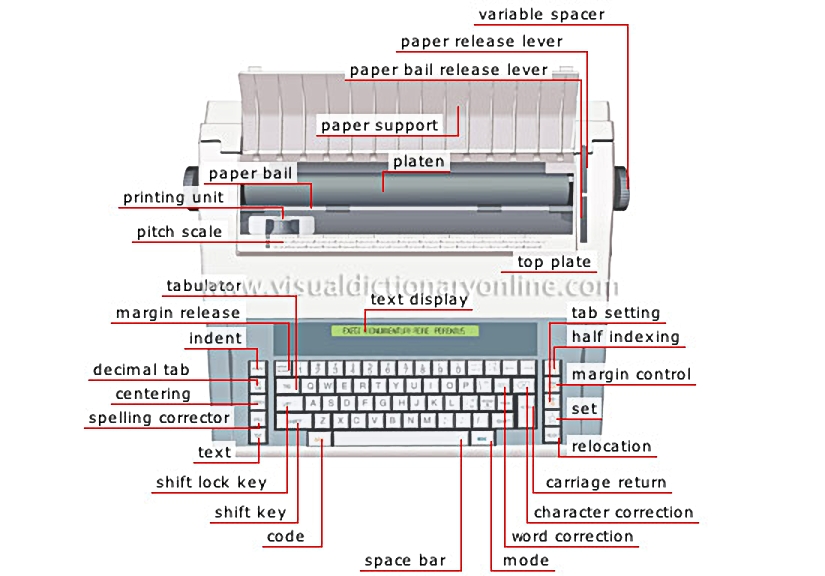
electronic typewriter
Equipment with a keyboard that is used to produce typewritten documents; it has certain word processing functions and an integrated memory.
mode
Key that is used with another key to choose a setting (character pitch, line spacing, ribbon type).
relocation
Key used to automatically reposition the printing unit or cursor at the last keystroke position before making a correction.
set
Key used to confirm the execution of a command or the choice of a setting.
carriage return
Key that moves the printing unit or cursor to the beginning of the next line.
character correction
Key used to erase the character next to the printing unit or cursor.
word correction
Key used to erase the word immediately to the left of the printing unit or cursor.
variable spacer
Thumb wheel that controls the rotation of the platen so the paper can be moved up or down.
paper release lever
Device that releases the pressure of the platen on the paper so that the paper can be cleared or moved.
code
Key that is used with another key to execute various programmed commands.
text
Key used to store texts in memory and to call them up later to make changes or to print them.
spelling corrector
Key used to activate or deactivate the automatic spell checking of text being keyed in.
shift key
Key used to produce a capital letter or the second character assigned to the key.
centering
Key used to center a text automatically between two margins or two tab stops.
shift lock key
Key that activates or deactivates the continuous keying of capital letters.
indent
Key used to move the left margin temporarily to indent a line or paragraph.
text display
Liquid crystal display that shows keyed-in text as well as information about the machine’s settings and operations carried out.
pitch scale
Graduated scale that shows the different spacing available; it is measured in number of characters per unit of length.
printing unit
Movable device with raised characters, which strike an inked ribbon to print on paper.
 previous