wide area network

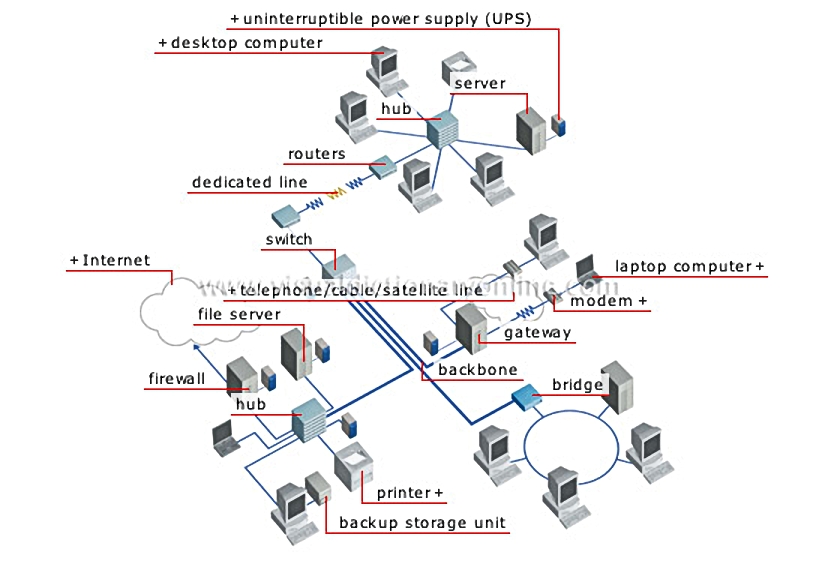
Private or public network spanning a large area (a region or country); it usually brings together several local area networks.
wide area network 						Unit that receives all messages sent by the devices connected to it and redistributes them to all users.				  							Device used to regulate the power supply to the computer and its peripherals by limiting the effects of cuts, surges or dips in the electric circuit voltage.												Small stand-alone microcomputer with a screen and integrated keyboard; it is powered by an internal battery.				  							Device that converts digital signals into analog signals so that computers can communicate with each other over telephone lines.												Linking of off-site devices by telephone network, cable network or telecommunications satellite.												Interconnecting device linking similar networks.				  							Storage peripheral used to copy data onto a removable medium to facilitate retrieval in the event of loss.				  							Output peripheral allowing computer-generated characters, images and graphics to be reproduced on paper.												Global network consisting of thousands of public and private networks of varying sizes; it is linked by a set of standard communications protocols.												Device controlling data that circulate between a public network (such as the Internet) and a private network; it prevents unauthorized access to the latter.				  							Server hosting a set of data files that are at the disposal of all computers connected to the network.				  							Interconnecting device linking different networks.				  							Unit establishing the connections needed to route data to intended users from one branch of a network to another; it also handles traffic between the various parts of a network.				  							Main artery of a network characterized by a high throughput; it transmits data between secondary networks.				  							Telephone or cable communications link reserved for one use or for a specific user.				  							Small workstation or microcomputer designed for stationary use.				  							Interconnecting devices ensuring transmission of data between two or more networks by determining the best path for them.				  							Computer that hosts various resources (including files, applications and databases) and places them at the disposal of all the devices connected to the network.				  							Unit that receives all messages sent by the devices connected to it and redistributes them to all users.
See Also


uninterruptible power supply (UPS)

modem

telecommunications by satellite

laser printer

Internet?[1]

ring network

star network

bus network

hub

Unit that receives all messages sent by the devices connected to it and redistributes them to all users.

uninterruptible power supply (UPS)

Device used to regulate the power supply to the computer and its peripherals by limiting the effects of cuts, surges or dips in the electric circuit voltage.
uninterruptible power supply (UPS)

laptop computer

Small stand-alone microcomputer with a screen and integrated keyboard; it is powered by an internal battery.

modem

Device that converts digital signals into analog signals so that computers can communicate with each other over telephone lines.
modem
modem

telephone/cable/satellite line

Linking of off-site devices by telephone network, cable network or telecommunications satellite.
telecommunications by satellite

bridge

Interconnecting device linking similar networks.

backup storage unit

Storage peripheral used to copy data onto a removable medium to facilitate retrieval in the event of loss.

printer

Output peripheral allowing computer-generated characters, images and graphics to be reproduced on paper.
laser printer
laser printer

Internet

Global network consisting of thousands of public and private networks of varying sizes; it is linked by a set of standard communications protocols.
Internet [1]
Internet [1]

firewall

Device controlling data that circulate between a public network (such as the Internet) and a private network; it prevents unauthorized access to the latter.

file server

Server hosting a set of data files that are at the disposal of all computers connected to the network.

gateway

Interconnecting device linking different networks.

switch

Unit establishing the connections needed to route data to intended users from one branch of a network to another; it also handles traffic between the various parts of a network.

backbone

Main artery of a network characterized by a high throughput; it transmits data between secondary networks.

dedicated line

Telephone or cable communications link reserved for one use or for a specific user.

desktop computer

Small workstation or microcomputer designed for stationary use.

routers

Interconnecting devices ensuring transmission of data between two or more networks by determining the best path for them.

server

Computer that hosts various resources (including files, applications and databases) and places them at the disposal of all the devices connected to the network.

hub

Unit that receives all messages sent by the devices connected to it and redistributes them to all users.