Milky Way

Spiral galaxy composed of 200 to 300 billion stars, including the Sun; thought to be 10 billion years old.
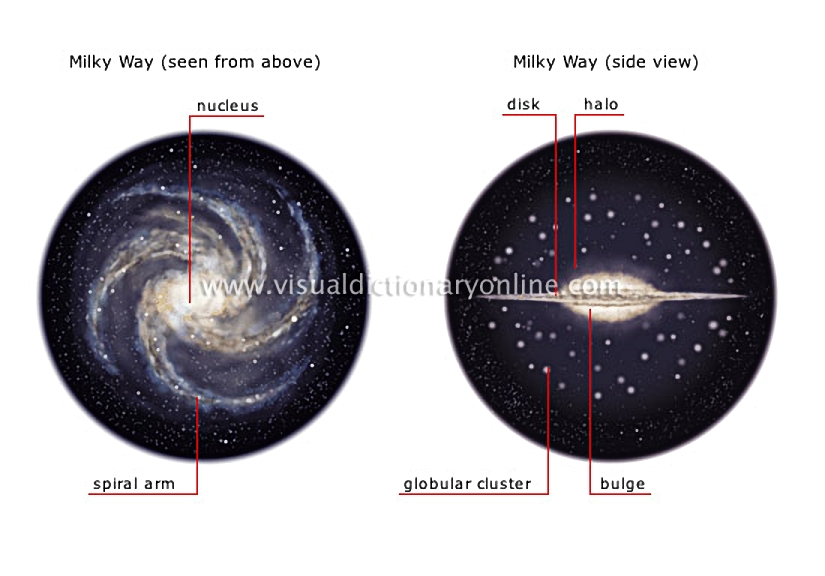
Milky Way 						From above, the Milky Way appears as a spiral that rotates on itself around a nucleus.				  							Central region of the bulge; the densest and most luminous region.				  							Curved grouping of stars influenced by the rotation of the galaxy around its nucleus.				  							From the side, the Milky Way appears as a disk because its spiral arms are seen from the same angle.				  							Region surrounding the galaxy, inhabited by isolated stars or groupings called globular clusters; the halo has a radius of about 50,000 light-years.				  							The main part of the galaxy, made up of a bulge and attaching arms.				  							The central bulge of the Milky Way’s disk; the densest region of the Milky Way, with a depth of 15,000 light-years.				  							Cluster made up of hundreds of thousands of old stars.
See Also


Hubbles classification

star

Milky Way (seen from above)

From above, the Milky Way appears as a spiral that rotates on itself around a nucleus.

nucleus

Central region of the bulge; the densest and most luminous region.

spiral arm

Curved grouping of stars influenced by the rotation of the galaxy around its nucleus.

Milky Way (side view)

From the side, the Milky Way appears as a disk because its spiral arms are seen from the same angle.

halo

Region surrounding the galaxy, inhabited by isolated stars or groupings called globular clusters; the halo has a radius of about 50,000 light-years.

disk

The main part of the galaxy, made up of a bulge and attaching arms.

bulge

The central bulge of the Milky Way’s disk; the densest region of the Milky Way, with a depth of 15,000 light-years.

globular cluster

Cluster made up of hundreds of thousands of old stars.