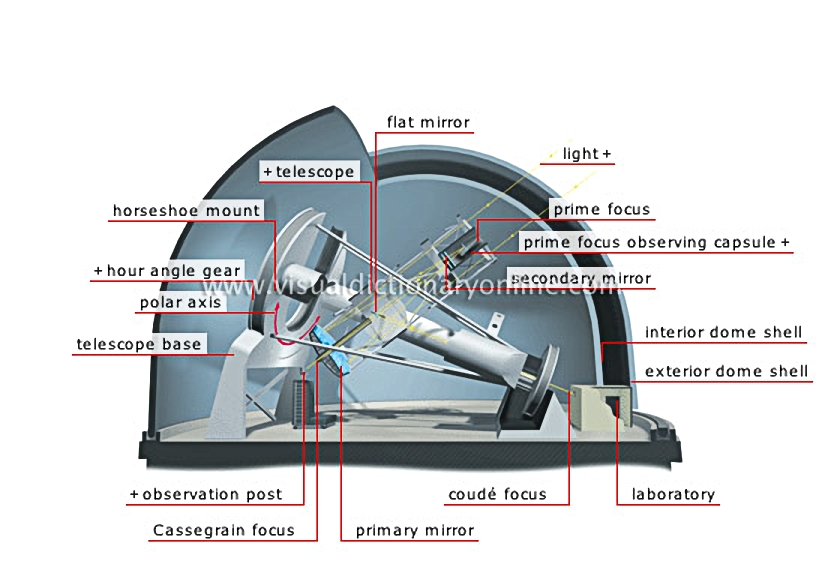
cross section of an astronomical observatory

cross section of an astronomical observatory 						Area where astronomers once gathered to monitor the exposure time of photographic plates.				  							Emitted by the celestial body, light is sent back toward the Cassegrain focus by the primary and secondary mirrors.												Focal point of the primary mirror where the light rays concentrate.				  							Area where most observations are carried out.				  							Focal point where the image forms; located behind the primary mirror.				  							Optical instrument that uses an objective mirror to observe celestial bodies.				  							Mirror that reflects the light of celestial bodies, directing it toward the prime focus.				  							Drive mechanism allowing the telescope to follow the polar axis.				  							Adjustable mirror making it possible to choose the location of the focus.				  							Pedestal on which the telescope mount rests.				  							Mount used to support a large telescope and point it toward the celestial pole.				  							Axis parallel to Earth’s axis of rotation; its rotation is opposite to that of Earth, making it possible to capture fixed images of an observed celestial body.				  							Mirror that intercepts light and redirects it toward the Cassegrain focus through a hole in the center of the primary mirror.				  							Area where the chemical composition of observed celestial bodies is studied using spectroscopy.				  							Focal point located at a distance from the telescope, obtained using a series of mirrors; stationary, it is used to conduct complex analyses and experiments.				  							Regulates the temperature of the telescope so as to avoid air turbulence and prevent the mirror from becoming deformed.				  							Protects against foul weather.

See Also


electromagnetic spectrum

celestial coordinate system

prime focus observing capsule

Area where astronomers once gathered to monitor the exposure time of photographic plates.

light

Emitted by the celestial body, light is sent back toward the Cassegrain focus by the primary and secondary mirrors.
electromagnetic spectrum

prime focus

Focal point of the primary mirror where the light rays concentrate.

observation post

Area where most observations are carried out.

Cassegrain focus

Focal point where the image forms; located behind the primary mirror.

telescope

Optical instrument that uses an objective mirror to observe celestial bodies.

primary mirror

Mirror that reflects the light of celestial bodies, directing it toward the prime focus.

hour angle gear

Drive mechanism allowing the telescope to follow the polar axis.

flat mirror

Adjustable mirror making it possible to choose the location of the focus.

telescope base

Pedestal on which the telescope mount rests.

horseshoe mount

Mount used to support a large telescope and point it toward the celestial pole.

polar axis

Axis parallel to Earth’s axis of rotation; its rotation is opposite to that of Earth, making it possible to capture fixed images of an observed celestial body.

secondary mirror

Mirror that intercepts light and redirects it toward the Cassegrain focus through a hole in the center of the primary mirror.

laboratory

Area where the chemical composition of observed celestial bodies is studied using spectroscopy.

coudé focus

Focal point located at a distance from the telescope, obtained using a series of mirrors; stationary, it is used to conduct complex analyses and experiments.

interior dome shell

Regulates the temperature of the telescope so as to avoid air turbulence and prevent the mirror from becoming deformed.

exterior dome shell

Protects against foul weather.