Doric order

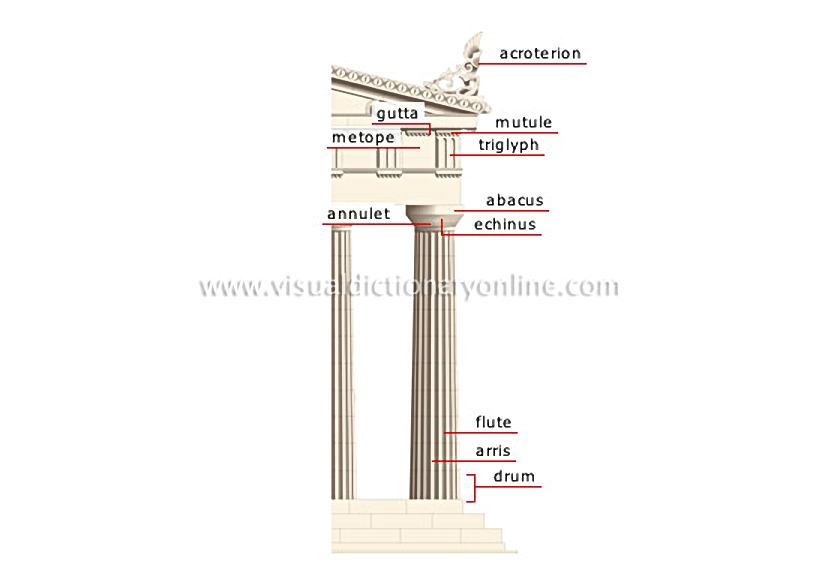
Order characterized by a squat column with no base, a capital that is not sculpted and a frieze with alternating triglyphs and metopes.
Doric order 						Each of the sections that make up the shaft of the column.				  							Line of intersection between two flutes, forming a sharp angle.				  							Vertical groove along the length of the column.				  							Ring-shaped ornament decorating the base of the capital.				  							Convex molding supporting the abacus.				  							Slab covering the capital and supporting the architrave.				  							Ornamental panel on the frieze; it is either smooth or sculpted.				  							Ornamental panel on the frieze that features two flutes framed on each side by half flutes.				  							Decorative motif located beneath the mutule.				  							Flat ornament, often adorned with drops, attached to the base of the cornice or the frieze.				  							Ornamental feature that rests on a base at the apex and corners of the pediment.
See Also


Greek temple?[1]

drum

Each of the sections that make up the shaft of the column.

arris

Line of intersection between two flutes, forming a sharp angle.

flute

Vertical groove along the length of the column.

annulet

Ring-shaped ornament decorating the base of the capital.

echinus

Convex molding supporting the abacus.

abacus

Slab covering the capital and supporting the architrave.

metope

Ornamental panel on the frieze; it is either smooth or sculpted.

triglyph

Ornamental panel on the frieze that features two flutes framed on each side by half flutes.

gutta

Decorative motif located beneath the mutule.

mutule

Flat ornament, often adorned with drops, attached to the base of the cornice or the frieze.

acroterion

Ornamental feature that rests on a base at the apex and corners of the pediment.