paramecium

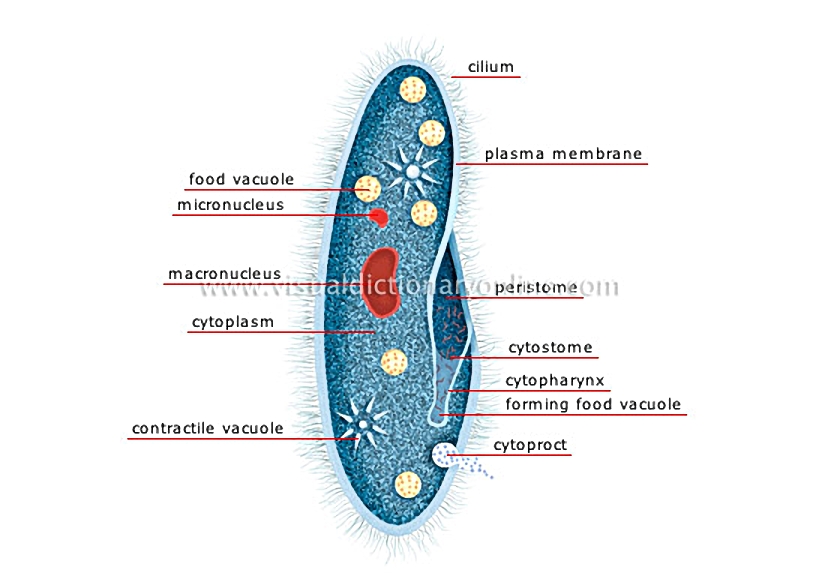
Ovoid-shaped one-cell organism generally found in freshwater and covered with cilia, which allow it to move about and to feed, mainly on bacteria.
paramecium 						Filament-like extension of the cytoplasmic membrane allowing the cell and certain substances on its surface to move about.				  							The cell’s flexible outer casing; it separates the cell from the surrounding environment and works as a filter to control the entry and exit of certain substances.				  							Depression lined with cilia, which undulate to direct food particles toward the cytostome.				  							Opening corresponding to the mouth and allowing ingestion of food and rejection of undesirable elements.				  							Fold of the plasma membrane; food particles originating in the cytostome are directed toward it.				  							The paramecium continually produces food vacuoles out of cytoplasmic membrane. Each food vacuole traps food particles accumulated in the bottom of the cytopharynx.				  							Orifice corresponding to the anus; the food vacuole opens into it, allowing waste to be eliminated.				  							Spheroid cavity acting as a pump to evacuate excess water and waste from the cell.				  							Clear gelatinous substance surrounding the various cellular structures.				  							Large nucleus controlling cellular activities.				  							Small nucleus ensuring cell reproduction.				  							Spheroid cavity in which food particles from the cytopharynx are digested.
See Also


animal cell

cilium

Filament-like extension of the cytoplasmic membrane allowing the cell and certain substances on its surface to move about.

plasma membrane

The cell’s flexible outer casing; it separates the cell from the surrounding environment and works as a filter to control the entry and exit of certain substances.

peristome

Depression lined with cilia, which undulate to direct food particles toward the cytostome.

cytostome

Opening corresponding to the mouth and allowing ingestion of food and rejection of undesirable elements.

cytopharynx

Fold of the plasma membrane; food particles originating in the cytostome are directed toward it.

forming food vacuole

The paramecium continually produces food vacuoles out of cytoplasmic membrane. Each food vacuole traps food particles accumulated in the bottom of the cytopharynx.

cytoproct

Orifice corresponding to the anus; the food vacuole opens into it, allowing waste to be eliminated.

contractile vacuole

Spheroid cavity acting as a pump to evacuate excess water and waste from the cell.

cytoplasm

Clear gelatinous substance surrounding the various cellular structures.

macronucleus

Large nucleus controlling cellular activities.

micronucleus

Small nucleus ensuring cell reproduction.

food vacuole

Spheroid cavity in which food particles from the cytopharynx are digested.