sponge

Porous multicell organism, mostly marine (currently about 5,000 species); it anchors itself to a support and filters water to take in food particles.
sponge 				  							Flat ectodermal cell forming the outer covering of the sponge.				  							Hollow portion of the sponge covered with choanocytes, in which water circulates before exiting through the osculum.				  							Gelatinous substance, rich in water, located between the ectoderm and the endoderm.				  							Inner layer of the sponge formed of cells (choanocytes) whose role is mainly to feed the organism.				  							Outer layer of the sponge formed of cells (pinacocytes) whose role is mainly to protect the organism.				  							Opening into the gastric cavity, through which water enters the sponge.				  							Large opening protected by spicules, through which the sponge discharges water from the gastric cavity.				  							Choanocyte flagella allow water to move inside the sponge, carrying oxygen and food particles to it.				  							Inner cell having a filament (flagellum), which allows water to circulate and food particles to be caught and digested.				  							Marine sponge with a skeleton composed of small calcareous needles (spicules).
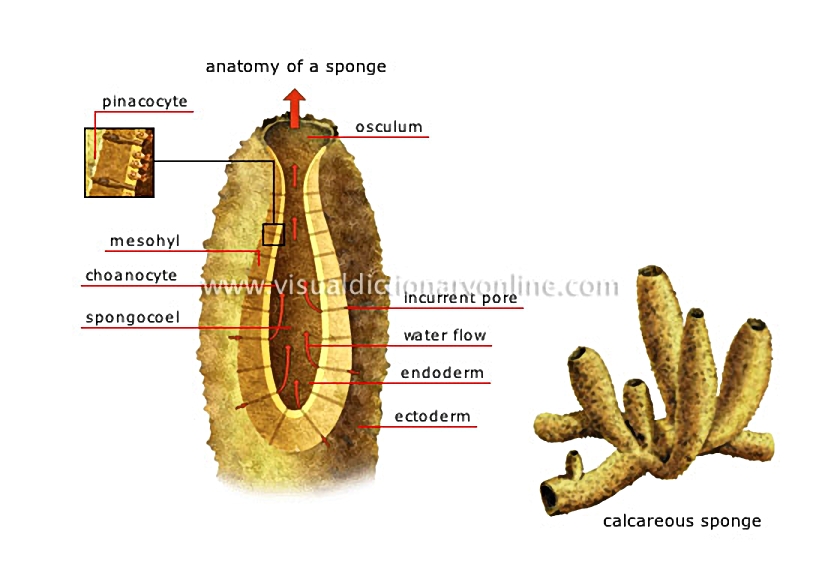
anatomy of a sponge

pinacocyte

Flat ectodermal cell forming the outer covering of the sponge.

spongocoel

Hollow portion of the sponge covered with choanocytes, in which water circulates before exiting through the osculum.

mesohyl

Gelatinous substance, rich in water, located between the ectoderm and the endoderm.

endoderm

Inner layer of the sponge formed of cells (choanocytes) whose role is mainly to feed the organism.

ectoderm

Outer layer of the sponge formed of cells (pinacocytes) whose role is mainly to protect the organism.

incurrent pore

Opening into the gastric cavity, through which water enters the sponge.

osculum

Large opening protected by spicules, through which the sponge discharges water from the gastric cavity.

water flow

Choanocyte flagella allow water to move inside the sponge, carrying oxygen and food particles to it.

choanocyte

Inner cell having a filament (flagellum), which allows water to circulate and food particles to be caught and digested.

calcareous sponge

Marine sponge with a skeleton composed of small calcareous needles (spicules).