morphology of a starfish

Starfish: carnivorous echinoderm found in the ocean depths; it generally has five arms, which allow it to crawl slowly along surfaces.
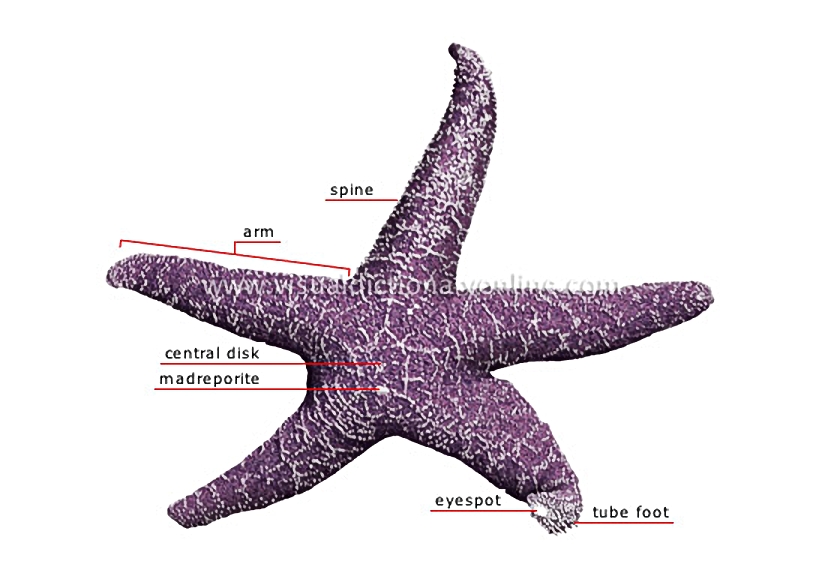
morphology of a starfish 						Small flexible tube extending and retracting with the action of the ampulla; it mainly allows the organism to move about, anchor itself to a support and capture its prey.				  							Central region of the body; the starfish’s arms are attached to it.				  							More or less movable outgrowths of calcareous plates forming the skeleton and enabling the starfish to ward off its predators.				  							Small light-sensitive structure located at the terminal end of each arm, allowing it to locate surfaces and prey.				  							Porous dorsal plate that allows water to enter the body; it connects the ambulacral ossicle to the outside world, and thus ensures locomotion.				  							Movable appendage radiating around the central disk; it has a mainly tactile and olfactory function. The starfish can regenerate an amputated arm.
tube foot

Small flexible tube extending and retracting with the action of the ampulla; it mainly allows the organism to move about, anchor itself to a support and capture its prey.

central disk

Central region of the body; the starfish’s arms are attached to it.

spine

More or less movable outgrowths of calcareous plates forming the skeleton and enabling the starfish to ward off its predators.

eyespot

Small light-sensitive structure located at the terminal end of each arm, allowing it to locate surfaces and prey.

madreporite

Porous dorsal plate that allows water to enter the body; it connects the ambulacral ossicle to the outside world, and thus ensures locomotion.

arm

Movable appendage radiating around the central disk; it has a mainly tactile and olfactory function. The starfish can regenerate an amputated arm.