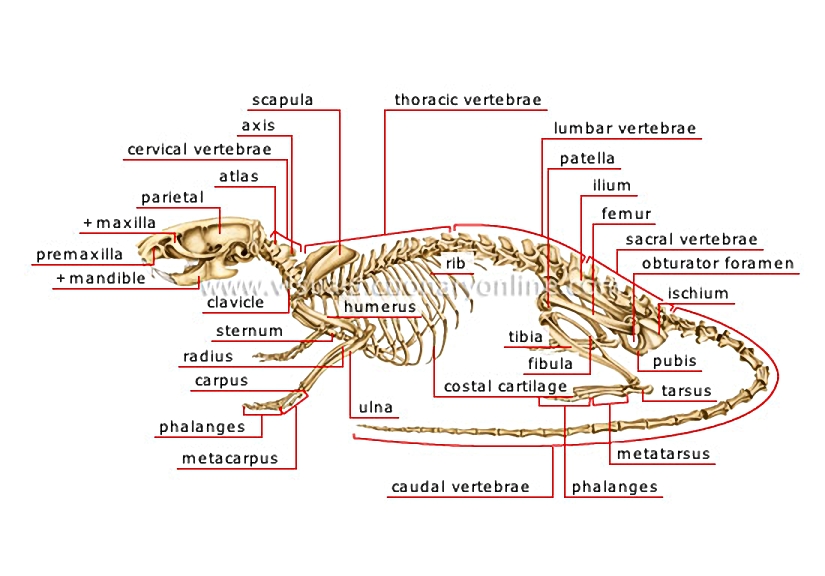
skeleton of a rat

skeleton of a rat 						Thin curved bone articulating with the vertebral column and the sternum.				  							Large thin flat shoulder bone articulating with the humerus.				  							Large flat back bone articulating with the sacral vertebrae.				  							Small flat slightly bulging triangular bone located on the inner limb and articulating especially with the femur.				  							Opening located in the lower part of the bone formed by the ilium, the ischium and the pubis; it is partly sealed by a membrane and muscles.				  							Long bone of the hind limb articulating especially with the patella.				  							Ventral bone posterior to the ilium.				  							Bone behind the ilium; the ilium, ischium and pubis fuse together to form a single bone to which the leg is attached.				  							Bones articulating to form the skeleton of the digits.				  							Part of the hind limb formed of several long bones; it connects the tarsus to the first phalanges of the digits.				  							Part of the hind limb formed of several small bones at the juncture of the tibia and the metatarsus.				  							Long bone partly fused to the fibula and forming the inner limb between the femur and the tarsus.				  							Long bone partly fused to the tibia and forming the outer limb between the femur and the tarsus.				  							Strong elastic tissue extending the front portion of the ribs to connect them to the sternum.				  							Partly fused bony parts between the lumbar and caudal vertebrae.				  							Bony parts supporting the ribs between the cervical and lumbar vertebrae.				  							Bony parts comprising the skeleton of the tail located at the terminal end of the vertebral column.				  							Long bone partly fused with the radius and forming the inner limb between the humerus and the carpus.				  							Long bone partly fused with the ulna and forming the outer limb between the humerus and the carpus.				  							Portion of the pectoral fin formed of short bones between the radius, the ulna and the metacarpus.				  							Elongated flat bone to which the ribs in particular are attached and bearing a crest on its ventral surface.				  							Bones articulating to form the skeleton of the digits.				  							Long bone located in the front ventral portion of the body articulating with the sternum.				  							Bone of the forelimb articulating with the scapula, as well as with the radius and the ulna; it provides a large base for the muscles.				  							First cervical vertebra supporting the head and supported by the axis.				  							Toothed bone forming the lower jaw.												Second cervical vertebra supporting the atlas; it allows the head to rotate.				  							Bony parts of the back located between the thoracic and sacral vertebrae.				  							Bony parts of the neck comprising the upper terminal end of the vertebral column.				  							Portion of the forelimb formed of several long bones; it connects the carpus to the first phalanges of the digits.				  							Bone forming the anterior portion of the upper jaw.				  							Flat bone of the upper portion of the skull.				  							Toothed bone forming, with the premaxilla, the upper jaw.

See Also


rodent’s jaw: rat

examples of rodents [1]

rib

Thin curved bone articulating with the vertebral column and the sternum.

scapula

Large thin flat shoulder bone articulating with the humerus.

ilium

Large flat back bone articulating with the sacral vertebrae.

patella

Small flat slightly bulging triangular bone located on the inner limb and articulating especially with the femur.

obturator foramen

Opening located in the lower part of the bone formed by the ilium, the ischium and the pubis; it is partly sealed by a membrane and muscles.

femur

Long bone of the hind limb articulating especially with the patella.

pubis

Ventral bone posterior to the ilium.

ischium

Bone behind the ilium; the ilium, ischium and pubis fuse together to form a single bone to which the leg is attached.

phalanges

Bones articulating to form the skeleton of the digits.

metatarsus

Part of the hind limb formed of several long bones; it connects the tarsus to the first phalanges of the digits.

tarsus

Part of the hind limb formed of several small bones at the juncture of the tibia and the metatarsus.

tibia

Long bone partly fused to the fibula and forming the inner limb between the femur and the tarsus.

fibula

Long bone partly fused to the tibia and forming the outer limb between the femur and the tarsus.

costal cartilage

Strong elastic tissue extending the front portion of the ribs to connect them to the sternum.

sacral vertebrae

Partly fused bony parts between the lumbar and caudal vertebrae.

thoracic vertebrae

Bony parts supporting the ribs between the cervical and lumbar vertebrae.

caudal vertebrae

Bony parts comprising the skeleton of the tail located at the terminal end of the vertebral column.

ulna

Long bone partly fused with the radius and forming the inner limb between the humerus and the carpus.

radius

Long bone partly fused with the ulna and forming the outer limb between the humerus and the carpus.

carpus

Portion of the pectoral fin formed of short bones between the radius, the ulna and the metacarpus.

sternum

Elongated flat bone to which the ribs in particular are attached and bearing a crest on its ventral surface.

phalanges

Bones articulating to form the skeleton of the digits.

clavicle

Long bone located in the front ventral portion of the body articulating with the sternum.

humerus

Bone of the forelimb articulating with the scapula, as well as with the radius and the ulna; it provides a large base for the muscles.

atlas

First cervical vertebra supporting the head and supported by the axis.

mandible

Toothed bone forming the lower jaw.
rodent’s jaw: rat
rodent’s jaw: rat

axis

Second cervical vertebra supporting the atlas; it allows the head to rotate.

lumbar vertebrae

Bony parts of the back located between the thoracic and sacral vertebrae.

cervical vertebrae

Bony parts of the neck comprising the upper terminal end of the vertebral column.
metacarpus

Portion of the forelimb formed of several long bones; it connects the carpus to the first phalanges of the digits.

premaxilla

Bone forming the anterior portion of the upper jaw.

parietal

Flat bone of the upper portion of the skull.

maxilla

Toothed bone forming, with the premaxilla, the upper jaw.
rodent’s jaw: rat
rodent’s jaw: rat