morphology of a turtle

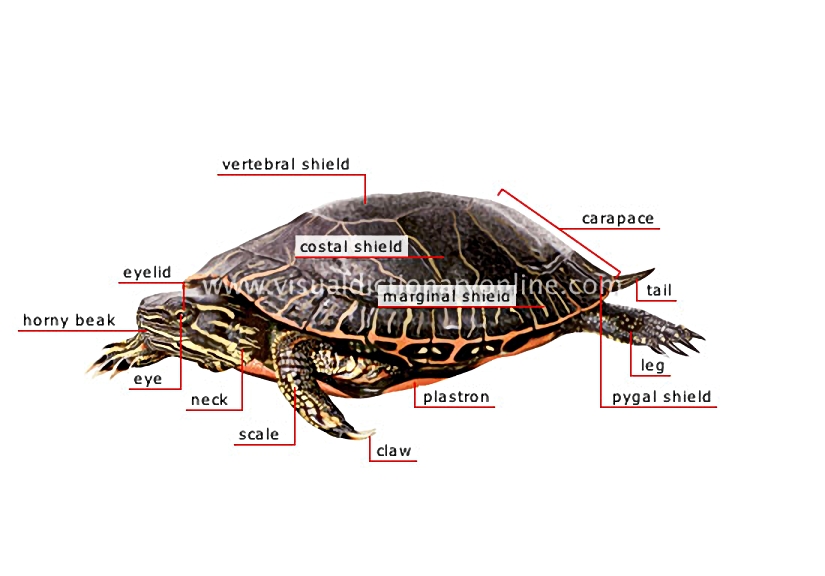
morphology of a turtle 						Relatively flat bony casing protecting the belly and cut away on the sides to allow the legs to move.				  							Bony casing in the shape of a rounded hump; it protects the back and connects to the plastron.				  							Short thick articulated limb bearing claws and used for walking or swimming, depending on the species.				  							Slightly curved, rigid pointy structure; the forelegs have five while the hind legs have four.				  							Each of the small hard thin overlapping plates covering the body of the turtle.				  							Thick cutaneous formation covering toothless jaws; its sharp edges allow the turtle to feed.				  							Organ of sight located on the head and having poor vision; it can make out motion and colors.				  							Each of the three movable muscular membranes protecting the anterior surface of the eye.				  							Long flexible portion of the body covered in small scales; the turtle folds it back to retract its head into the carapace.				  							Large corneous scales set in a row on each side of the back shell.				  							Large corneous scales set in a row on the middle portion of the back shell.				  							Small corneous scales set in a row around the back shell.				  							Small terminal appendage of the body that retracts into the carapace.				  							Very small corneous scale located on the posterior portion of the back shell, above the tail.
plastron

Relatively flat bony casing protecting the belly and cut away on the sides to allow the legs to move.

carapace

Bony casing in the shape of a rounded hump; it protects the back and connects to the plastron.

leg

Short thick articulated limb bearing claws and used for walking or swimming, depending on the species.

claw

Slightly curved, rigid pointy structure; the forelegs have five while the hind legs have four.

scale

Each of the small hard thin overlapping plates covering the body of the turtle.

horny beak

Thick cutaneous formation covering toothless jaws; its sharp edges allow the turtle to feed.

eye

Organ of sight located on the head and having poor vision; it can make out motion and colors.

eyelid

Each of the three movable muscular membranes protecting the anterior surface of the eye.

neck

Long flexible portion of the body covered in small scales; the turtle folds it back to retract its head into the carapace.

costal shield

Large corneous scales set in a row on each side of the back shell.

vertebral shield

Large corneous scales set in a row on the middle portion of the back shell.

marginal shield

Small corneous scales set in a row around the back shell.

tail

Small terminal appendage of the body that retracts into the carapace.

pygal shield

Very small corneous scale located on the posterior portion of the back shell, above the tail.