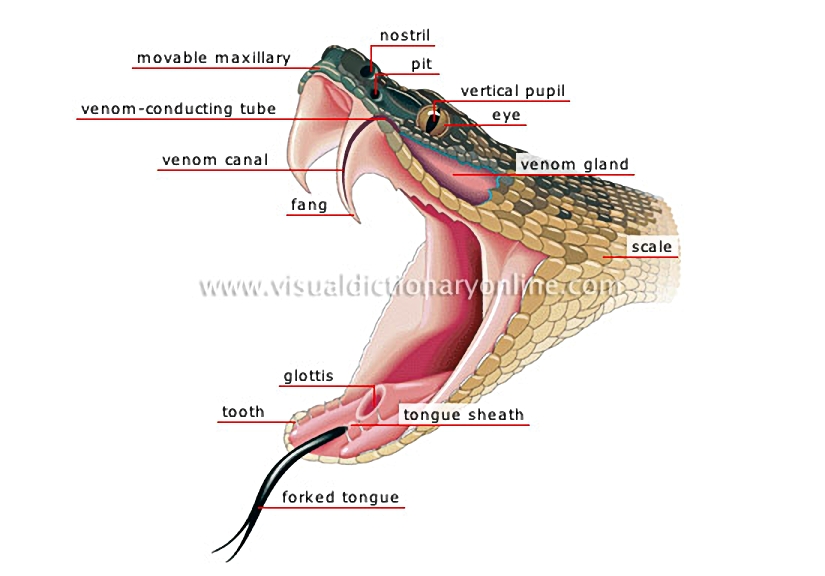
morphology of a venomous snake: head
Venomous snake: it defends itself by injecting often deadly venom; there are about 400 species.
movable maxillary
Highly mobile bone of the upper jaw allowing the snake to swallow large prey.
scale
Each of the overlapping small hard thin plates covering the snake’s body.
tongue sheath
Protective sheath located in front of the glottis into which the tongue retracts.
forked tongue
Elongated movable forked mouthpart having olfactory, tactile and gustatory functions; it is not used to ingest food.
tooth
Hard pointy structure that curves backward and is fixed to the jaws; it grows continually and is used to immobilize prey but not to chew.
glottis
Opening in the respiratory system located in the lower portion of the buccal cavity, through which air circulates.
venom gland
Organ producing an acidic secretion made of venom; it is attached to the fang.
fang
Large curved tooth located on the maxilla and connected to the venom gland; it allows the snake to grab its prey to inject it with venom.
venom-conducting tube
Tube carrying venom from the venom gland to the venom canal.
venom canal
Hollow fissure in the fang allowing venom to be injected by biting.
pit
Sensory organ forming a cavity between the eye and the nostril; it allows the snake to sense variations in temperature and to locate its prey.
eye
Organ of sight covered with a transparent scale; it has a wide field of vision and mainly perceives motion and colors.
vertical pupil
Oval and vertical opening of the eye, especially adapted to the dark; image-producing light enters through it.
nostril
External orifice of the nasal cavity located above the mouth and having olfactory and respiratory functions.
![examples-amphibians [2]](../../../images/flechePrevious.gif "examples-amphibians [2] image") previous
previous
