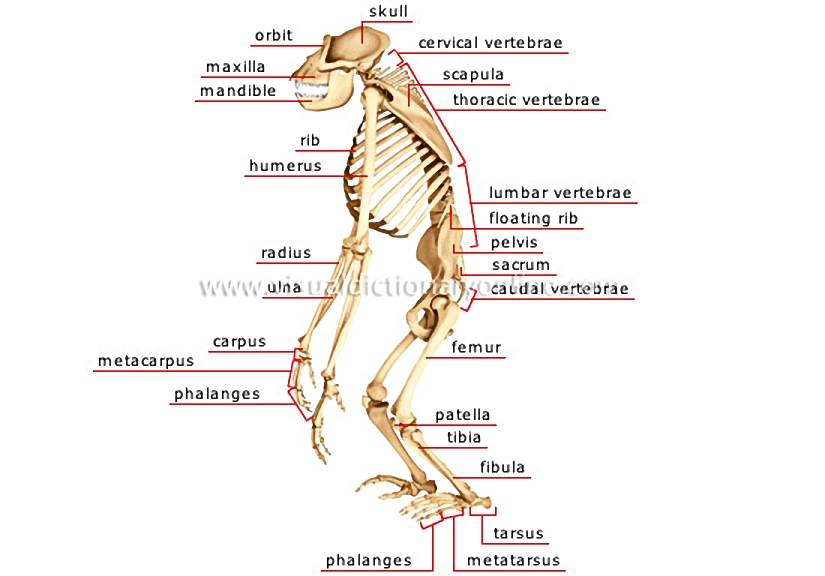
skeleton of a gorilla

skeleton of a gorilla 						Bony parts of the back between the dorsal vertebrae and the sacrum.				  							Bony parts supporting the ribs between the cervical and lumbar vertebrae.				  							Bony parts of the neck comprising the upper terminal end of the vertebral column.				  							Large flat thin back bone articulating with the humerus.				  							Thin curved bone whose terminal end articulates with the vertebrae, while the other end remains free.				  							Bony girdle to which the legs are attached; the elongated shape of the pelvis prevents the gorilla from remaining upright for very long.				  							Bone resulting from the fusion of several vertebrae and located between the lumbar and caudal vertebrae; the pelvis articulates with it.				  							Bony parts fused together at the terminal end of the vertebral column and articulating with the sacrum.				  							Long bone of the hind limb articulating with the pelvis, the tibia and the fibula.				  							Small, slightly bulging triangular bone located on the front surface of the leg and articulating especially with the femur.				  							Long bone forming the inner portion of the leg located between the femur and the tarsus (foot bone).				  							Long bone forming the outer portion of the leg located between the femur and the tarsus (foot bone).				  							Portion of the leg formed of short bones between the tibia, the fibula and the metatarsus.				  							Portion of the leg formed of several long bones and connecting the tarsus with the first phalange of the digit.				  							Bones articulating to form the skeleton of the digits.				  							Bones articulating to form the skeleton of the digits.				  							Part of the arm formed of several long bones and connecting the carpus with the first phalange of the digit.				  							Portion of the arm formed of short bones between the radius, the ulna and the metacarpus.				  							Long bone forming the inner arm between the humerus and the carpus.				  							Long bone making up the outer section of the forearm; it is connected especially to the carpal bones to form the wrist joint.				  							Long arm bone articulating with the scapula to form the shoulder, and with the radius and the ulna to form the elbow.				  							Thin curved bone articulating with the vertebral column and the sternum.				  							Toothed bone forming the lower jaw.				  							Toothed bone comprising the upper jaw.				  							Bony cavity of the upper portion of the head containing the eye.				  							Bony structure enclosing and protecting the brain.

lumbar vertebrae

Bony parts of the back between the dorsal vertebrae and the sacrum.

thoracic vertebrae

Bony parts supporting the ribs between the cervical and lumbar vertebrae.

cervical vertebrae

Bony parts of the neck comprising the upper terminal end of the vertebral column.

scapula

Large flat thin back bone articulating with the humerus.

floating rib

Thin curved bone whose terminal end articulates with the vertebrae, while the other end remains free.

pelvis

Bony girdle to which the legs are attached; the elongated shape of the pelvis prevents the gorilla from remaining upright for very long.

sacrum

Bone resulting from the fusion of several vertebrae and located between the lumbar and caudal vertebrae; the pelvis articulates with it.

caudal vertebrae

Bony parts fused together at the terminal end of the vertebral column and articulating with the sacrum.

femur

Long bone of the hind limb articulating with the pelvis, the tibia and the fibula.

patella

Small, slightly bulging triangular bone located on the front surface of the leg and articulating especially with the femur.

tibia

Long bone forming the inner portion of the leg located between the femur and the tarsus (foot bone).

fibula

Long bone forming the outer portion of the leg located between the femur and the tarsus (foot bone).

tarsus

Portion of the leg formed of short bones between the tibia, the fibula and the metatarsus.

metatarsus

Portion of the leg formed of several long bones and connecting the tarsus with the first phalange of the digit.

phalanges

Bones articulating to form the skeleton of the digits.

phalanges

Bones articulating to form the skeleton of the digits.

metacarpus

Part of the arm formed of several long bones and connecting the carpus with the first phalange of the digit.

carpus

Portion of the arm formed of short bones between the radius, the ulna and the metacarpus.

ulna

Long bone forming the inner arm between the humerus and the carpus.

radius

Long bone making up the outer section of the forearm; it is connected especially to the carpal bones to form the wrist joint.

humerus

Long arm bone articulating with the scapula to form the shoulder, and with the radius and the ulna to form the elbow.

rib

Thin curved bone articulating with the vertebral column and the sternum.
mandible

Toothed bone forming the lower jaw.

maxilla

Toothed bone comprising the upper jaw.

orbit

Bony cavity of the upper portion of the head containing the eye.

skull

Bony structure enclosing and protecting the brain.