morphology of a kangaroo

morphology of a kangaroo 						Very muscular terminal appendage; it helps maintain equilibrium while jumping and, with the back legs, supports the body at rest.				  							Located on the female’s belly and having nipples; the newborn continues to develop inside it. In some species, the pouch is dorsal or absent.				  							Upper portion of the hind limb; its muscles provide the kangaroo with strong propulsion.				  							Powerful terminal end of the limb bearing four digits; it supports the body and has a motor function.				  							Articulated limb at the end of the foot. The kangaroo does not usually have a thumb. The 2nd and 3rd digits are fused, while the 4th digit ends in a strong sharp claw.				  							Pointy sharp corneous structure used especially to scratch and claw adversaries during combat.				  							Poorly developed articulated limb ending in five clawed digits; the kangaroo uses it to feed and to defend itself.				  							Long front portion of the head having mainly a highly developed olfactory function.				  							Movable outer portion of the ear made of cartilage and located on the side of the head to capture sounds.				  							Hair covering the body, mainly for maintaining body temperature; the fur insulates against cold and heat.				  							Extremely muscular articulated limb ending in four digits allowing the kangaroo to move swiftly by powerful bounds and to strike its enemies.
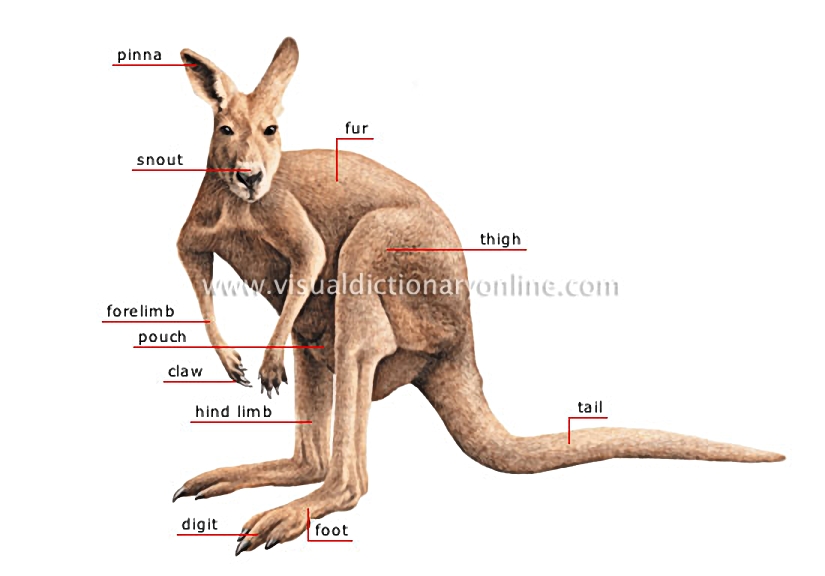
tail

Very muscular terminal appendage; it helps maintain equilibrium while jumping and, with the back legs, supports the body at rest.

pouch

Located on the female’s belly and having nipples; the newborn continues to develop inside it. In some species, the pouch is dorsal or absent.

thigh

Upper portion of the hind limb; its muscles provide the kangaroo with strong propulsion.

foot

Powerful terminal end of the limb bearing four digits; it supports the body and has a motor function.

digit

Articulated limb at the end of the foot. The kangaroo does not usually have a thumb. The 2nd and 3rd digits are fused, while the 4th digit ends in a strong sharp claw.

claw

Pointy sharp corneous structure used especially to scratch and claw adversaries during combat.

forelimb

Poorly developed articulated limb ending in five clawed digits; the kangaroo uses it to feed and to defend itself.

snout

Long front portion of the head having mainly a highly developed olfactory function.

pinna

Movable outer portion of the ear made of cartilage and located on the side of the head to capture sounds.

fur

Hair covering the body, mainly for maintaining body temperature; the fur insulates against cold and heat.

hind limb

Extremely muscular articulated limb ending in four digits allowing the kangaroo to move swiftly by powerful bounds and to strike its enemies.