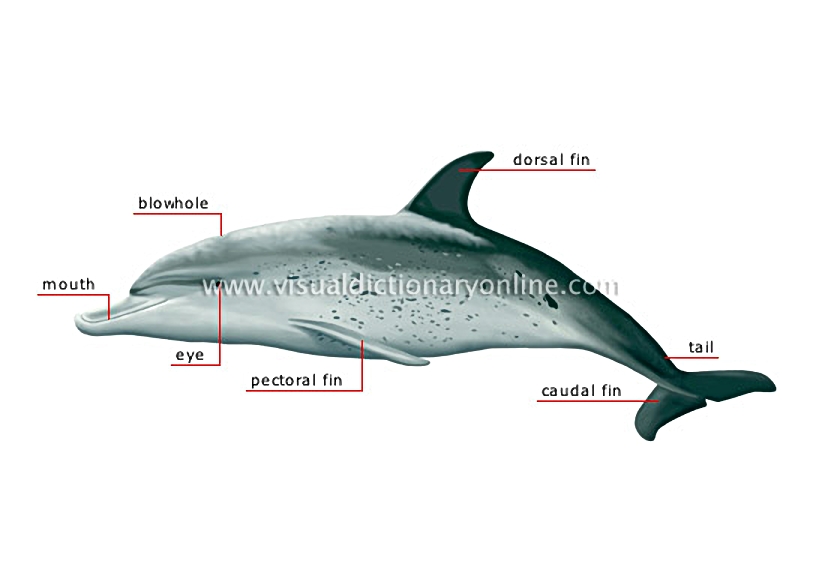
blowhole 
Opening in the nasal cavity located on the top of the head allowing respiration.
dorsal fin
Swimming appendage made of dense fibrous tissue located in the middle of the back and providing stability and thermoregulation; some marine mammals do not have a dorsal fin.
tail
Terminal part of the body whose vertical movements propel the dolphin; the tail is controlled by powerful muscles inserted in the vertebral column.
caudal fin
Powerful swimming appendage with two lobes formed of dense fibrous tissue located vertically at the posterior terminal part of the body; its function is propulsion.
pectoral fin
Swimming appendage made of bone that ensures stability, orientation, stopping and thermoregulation.
eye
Organ of sight located on the side of the head adapted equally well to seeing in or out of water.
mouth
Anterior cavity of the digestive tract formed by the maxilla and the mandible allowing ingestion of food.
![examples-carnivorous-mammals [5]](../../../images/flechePrevious.gif "examples-carnivorous-mammals [5] image") previous
previous