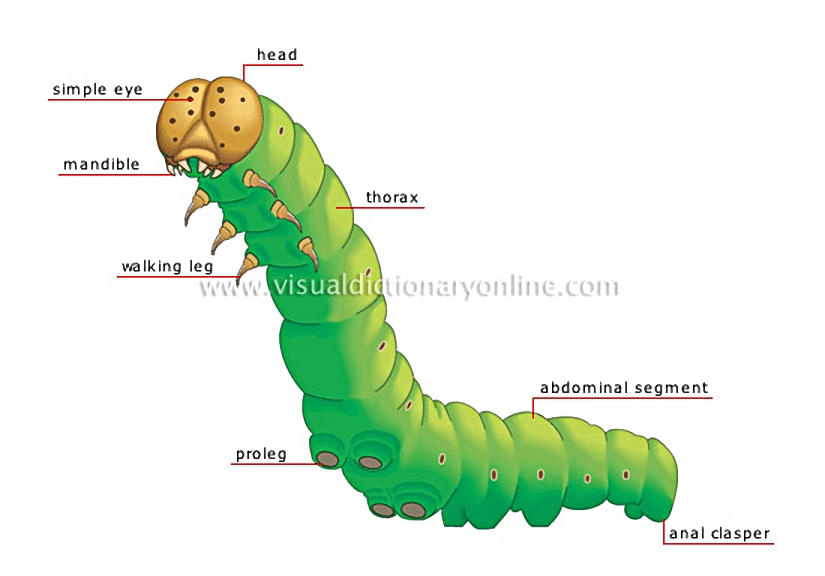
caterpillar
Butterfly larva having a long body and 10 feet; the intermediary stage between the egg and the chrysalis.
anal clasper
Last of five pairs of prolegs; it is located at the terminal part of the caterpillar’s body.
thorax
Part of the caterpillar’s body divided into three segments; the walking legs are attached to it.
proleg
Adhesive disk located below the abdomen that disappears in the adult stage; the caterpillar usually has five pairs, including the anal claspers.
walking leg
Articulated member having a motor function; it remains in the adult stage. The caterpillar has three pairs.
simple eye
Organ of vision formed of a single facet that captures variations in luminosity and allows the caterpillar to orient itself.
head
Anterior portion of the body of the caterpillar containing the main sensory organs.
 previous
![morphology-honeybee-worker [1]](../../../images/flecheNext.gif "morphology-honeybee-worker [1] image")